
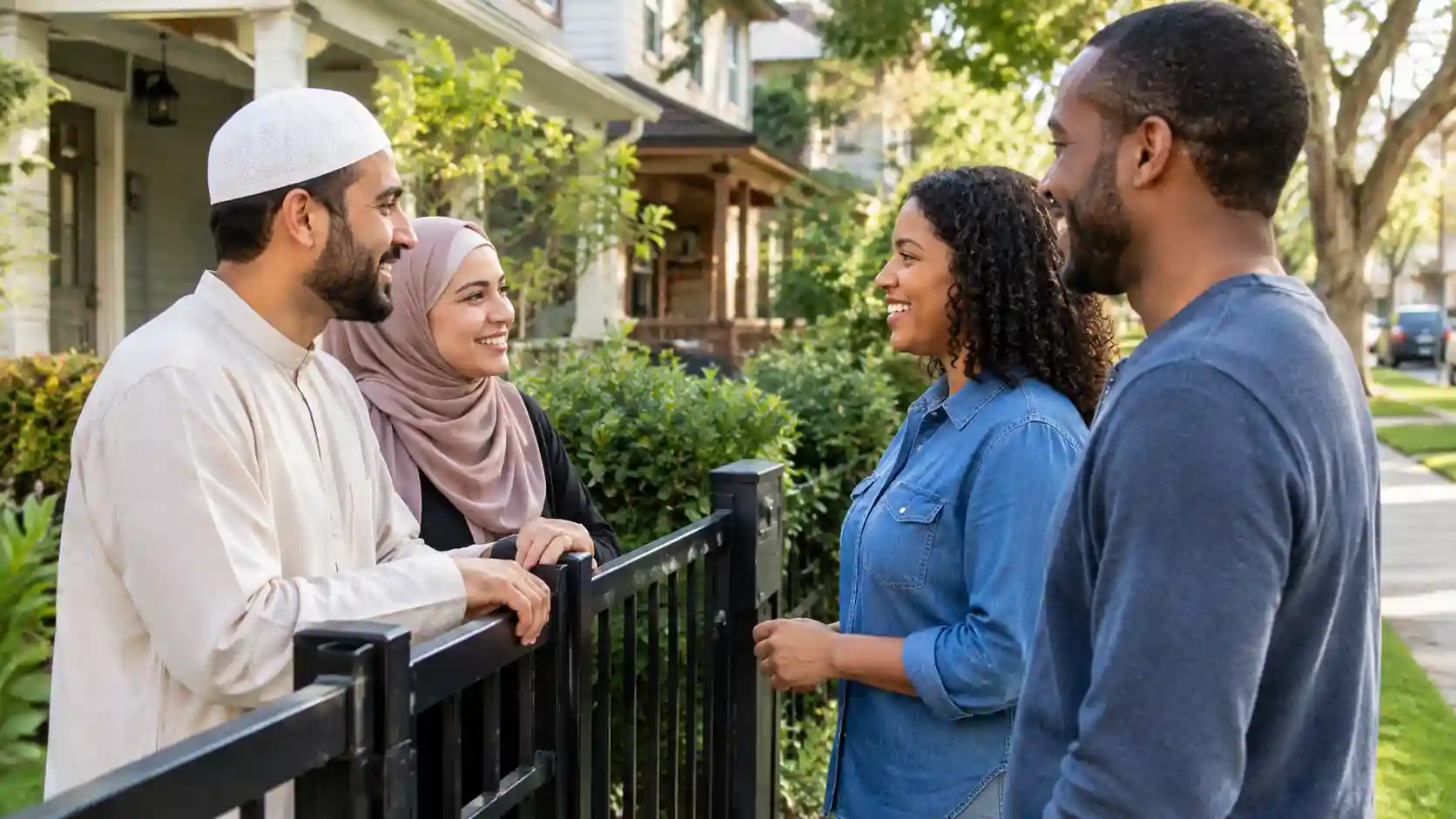
Living next door to someone is more than simply sharing a wall, street, apartment building, or neighborhood. A neighbor may be the person you meet every morning, the family living across the street, or someone you rarely speak to but whose life is affected by the way you behave.
So, what does Islam say about neighbors?
Islam places significant importance on treating neighbors with kindness, respect, fairness, and good manners. The Quran specifically mentions near and distant neighbors among the people toward whom Muslims should show goodness. The Prophet Muhammad ﷺ also repeatedly emphasized good treatment of neighbors and warned against harming them.
This guidance is practical. It includes avoiding unnecessary disturbance, respecting privacy, helping when there is a genuine need, speaking politely, sharing when appropriate, and dealing fairly with people of different backgrounds and beliefs.
These principles are particularly relevant today. Muslims in the United States, United Kingdom, Canada, and other multicultural societies often live alongside people from different religions, cultures, and traditions.
Being a good neighbor does not require abandoning your Islamic beliefs. Rather, it means putting Islamic manners into practice while respecting the rights and dignity of the people around you.
What Does Islam Say About Neighbors?
The basic Islamic teaching is simple: treat your neighbors well and do not harm them.
The Quran places neighbors alongside parents, relatives, orphans, people in need, companions, and travelers when describing people toward whom Muslims should show goodness. This demonstrates that neighborly responsibility is part of a wider Islamic approach to social conduct.
The Prophet Muhammad ﷺ also gave strong emphasis to neighbors. Aisha رضي الله عنها narrated that the Prophet ﷺ said that Jibril continued advising him concerning the neighbor until he thought the neighbor might even be given a share of inheritance. This is recorded in Sahih al-Bukhari 6014.
The point is not that neighbors actually became legal heirs. Rather, the wording illustrates how repeatedly and seriously the Prophet ﷺ was instructed to care about the rights of neighbors.
Islamic teachings about neighbors therefore include two important sides:
- Doing good to neighbors
- Avoiding harm to neighbors
Good neighborliness is not limited to occasional gifts or friendly conversations. It also means controlling our behavior when our actions could inconvenience, frighten, disturb, or harm someone living nearby.
What Does the Quran Say About Neighbors?
One of the clearest Quranic references to neighbors appears in Surah An-Nisa 4:36.
The verse commands believers to worship Allah alone and then mentions goodness toward several groups, including parents, relatives, orphans, those in need, the near neighbor and the neighbor farther away, as well as companions and travelers.
A short portion can be summarized as:
“…the near neighbor, the neighbor farther away…” — Quran 4:36
The verse connects worship of Allah with good treatment of people. It also mentions both near and more distant neighbors.
Scholars have discussed the possible meanings of the categories of “near” and “far” neighbors. They can include differences in physical proximity and, according to some explanations, differences in relationship or connection. Because the exact scope has been discussed in tafsir, it is better not to claim that the verse establishes one precise definition of how many houses count as neighbors.
The important principle is clear: neighbors deserve consideration and good treatment.
The verse also teaches that Islamic social responsibility extends beyond one’s immediate family. A person’s relationship with Allah should be reflected in how that person treats people around them.
For Muslims, this can mean asking practical questions:
- Am I disturbing people around me?
- Do I respect my neighbors’ privacy?
- Do I help when someone genuinely needs assistance?
- Do I treat people fairly even when they have different beliefs?
- Do my words and actions make my neighborhood safer and more peaceful?
These questions bring Quranic guidance into everyday life.
What Are the Rights of Neighbors in Islam?
Islamic sources strongly establish the importance of good treatment and avoiding harm. However, it is useful to be precise: not every example below is a separately defined legal “right” in Islamic law. Some are practical applications of general Islamic principles of kindness, justice, good character, and avoiding harm.
Important neighborly responsibilities include:
1. Being safe from harm
A neighbor should not have to fear deliberate harassment, intimidation, or harmful behavior from someone living nearby.
The Prophet ﷺ specifically warned believers against harming their neighbors.
2. Being treated respectfully
Neighbors should be spoken to politely and treated with dignity, regardless of differences in age, culture, ethnicity, or religion.
3. Receiving kindness
Small acts of kindness can strengthen relationships. A greeting, thoughtful gesture, food, or practical assistance can all contribute to good neighborly relations.
4. Help during genuine need
If a neighbor faces a reasonable and genuine difficulty, helping when you are able can be an expression of Islamic character.
5. Respect for privacy
Do not unnecessarily investigate your neighbor’s private life, enter their property without permission, or spread personal information.
6. Avoiding unnecessary disturbance
Excessive noise, repeated late-night disturbances, or careless behavior that seriously interferes with a neighbor’s life should be avoided.
7. Consideration in shared spaces
People living in apartments and shared buildings should be considerate about hallways, parking areas, elevators, laundry rooms, trash areas, and other shared facilities.
8. Sharing food and gifts
Giving food or a small gift can be a simple way to show kindness.
The Prophet ﷺ taught Muslims not to consider even a small gift insignificant. In Sahih al-Bukhari 2566, Abu Hurairah رضي الله عنه narrated the Prophet’s teaching concerning neighbors giving gifts, mentioning even a sheep’s trotter as an example.
9. Helping in difficult circumstances
A neighbor may need assistance during illness, severe weather, an emergency, or another temporary difficulty.
10. Maintaining good manners
Even when neighbors disagree, Islamic manners call for restraint, fairness, and avoidance of unnecessary hostility.
What Does the Prophet Muhammad ﷺ Teach About Neighbors?
Several authentic Hadith make the importance of neighbors especially clear.
Jibril repeatedly advised about neighbors
Aisha رضي الله عنها narrated that Jibril continued advising the Prophet ﷺ about neighbors until he thought that Jibril might order that the neighbor be made an heir.
This is recorded in Sahih al-Bukhari 6014.
It shows the extraordinary importance given to neighborly conduct.
Do not harm your neighbor
Abu Hurairah رضي الله عنه narrated that the Prophet ﷺ said:
“He who believes in Allah and the Last Day does not harm his neighbour…”
This is recorded in Sahih Muslim 47b and also in Sahih al-Bukhari 6018.
This teaching is especially important because it makes avoiding harm part of the practical expression of faith.
Honor your neighbor
Another narration from Abu Hurairah رضي الله عنه states that whoever believes in Allah and the Last Day should honor his neighbor. This is recorded in Sahih Muslim 47a.
Together, these narrations give a balanced picture:
Islam encourages positive treatment of neighbors and prohibits harmful behavior toward them.
How Should Muslims Treat Their Neighbors?
Being a good neighbor does not have to involve dramatic gestures. Much of it is ordinary consideration.
A Muslim can practice good neighbor etiquette by:
- Greeting neighbors politely.
- Respecting their privacy.
- Keeping unnecessary noise under control.
- Keeping shared areas clean.
- Avoiding blocking driveways, entrances, or shared access.
- Returning things that have been borrowed.
- Offering reasonable help when someone needs it.
- Being considerate about parking.
- Avoiding gossip about neighbors.
- Speaking calmly during disagreements.
- Apologizing when you cause an inconvenience.
- Respecting different cultures and beliefs.
- Sharing food when appropriate.
- Checking on an elderly or vulnerable neighbor when doing so is appropriate and safe.
For someone living in an apartment in New York, London, Toronto, or another large city, this might mean respecting building quiet hours and shared facilities.
For someone living in a suburban house, it might mean keeping noise, parking, pets, children, rubbish, and outdoor activities from unnecessarily disturbing nearby households.
The exact situation varies, but the principle remains the same: consider how your behavior affects people around you.
What About Non-Muslim Neighbors?
This is an important question for Muslims living in diverse communities.
Islamic teachings about good character and fair treatment are not limited to Muslim neighbors.
The Quran states in Surah Al-Mumtahanah 60:8 that Allah does not forbid Muslims from dealing kindly and justly with those who have not fought them because of religion or driven them from their homes.
This verse provides an important principle of kindness and justice toward peaceful people outside the Muslim community.
Therefore, a Muslim can have respectful and good relationships with non-Muslim neighbors while maintaining Islamic beliefs and practices.
A Muslim may:
- Greet a neighbor politely.
- Give a suitable gift.
- Share permissible food.
- Help with practical matters.
- Offer assistance during an emergency.
- Show sympathy during difficult circumstances.
- Respect a neighbor’s property and privacy.
- Participate in appropriate community activities.
- Cooperate on neighborhood matters.
At the same time, Muslims should distinguish between being kind to someone and participating in religious practices that conflict with Islamic beliefs.
The details of particular situations can differ, so specific religious questions may require consultation with a qualified scholar.
The general principle is straightforward: religious difference does not by itself justify rudeness, injustice, or harm.
How Can You Be a Good Muslim Neighbor?
Use this simple checklist:
☐ Keep unnecessary noise under control
☐ Respect your neighbor’s privacy
☐ Keep your property and shared spaces reasonably clean
☐ Offer help when appropriate
☐ Share food occasionally when suitable
☐ Be considerate with parking
☐ Respect different cultures and religions
☐ Avoid gossip and rumors
☐ Do not intentionally disturb others
☐ Be polite during disagreements
☐ Respect property boundaries
☐ Return borrowed items
☐ Apologize when you cause an inconvenience
☐ Help during genuine emergencies when reasonably possible
Good neighborliness often comes down to small habits repeated consistently.
What Should Muslims Avoid Doing to Their Neighbors?
The Prophet’s teachings about not harming neighbors make this area especially important.
Muslims should avoid behavior such as:
- Excessive or unnecessary noise
- Insults and abusive language
- Gossip
- Spreading rumors
- Harassment
- Blocking entrances or driveways
- Misusing shared spaces
- Leaving rubbish where it creates a problem
- Damaging another person’s property
- Creating unnecessary disputes
- Repeatedly ignoring reasonable concerns
- Deliberately disturbing a neighbor
- Invading someone’s privacy
Not every one of these examples has an identical legal ruling in Islamic law. For example, an accidental inconvenience is not the same as deliberately harming someone.
The important distinction is intent, circumstances, degree of harm, and the rights involved.
Where a behavior causes genuine harm or violates another person’s rights, the Islamic concern becomes more serious.
Does Islam Encourage Helping Neighbors?
Yes, helping people is consistent with the broader Islamic teachings of kindness, charity, compassion, and social responsibility.
Helping a neighbor does not necessarily require money.
You might:
- Help carry a heavy item.
- Bring food to someone who is struggling.
- Check on an elderly neighbor.
- Offer practical assistance during illness.
- Help during severe weather.
- Give directions to someone who is lost.
- Help a family facing a temporary difficulty.
- Assist someone during an emergency when it is safe to do so.
The Quran’s mention of neighbors alongside people in need reinforces the importance of social responsibility.
However, it is better to describe these actions as expressions of Islamic kindness rather than attaching a specific promised reward to every individual action unless an authentic source establishes that reward.
What If You Have a Difficult Neighbor?
Islam encourages patience and good character, but this does not mean a person must silently accept abuse, threats, or serious danger.
If you have a difficult neighbor, consider a balanced approach:
Stay calm
Avoid responding to anger with more anger.
Communicate respectfully
If the situation is safe, explain the problem calmly and focus on the specific behavior rather than attacking the person’s character.
Set reasonable boundaries
You can be polite while still making clear what behavior is unacceptable.
Keep records of serious problems
For repeated noise, property damage, threats, harassment, or other serious issues, keeping appropriate documentation can be useful.
Seek mediation
In some situations, a landlord, building manager, community mediator, or another appropriate person may help resolve the dispute.
Use appropriate authorities when necessary
If there are threats, violence, stalking, serious property damage, or another genuine danger, seek appropriate local assistance. Protecting yourself and your family is important.
Being patient does not mean allowing someone to repeatedly harm you.
Islamic Etiquette for Living in a Neighborhood
Modern neighborhoods create many situations that earlier communities experienced differently, but the underlying principles remain relevant.
Apartments and shared buildings
Respect building rules, quiet hours, elevators, hallways, laundry rooms, parking areas, and shared facilities.
Suburban neighborhoods
Be considerate about lawn maintenance, parties, outdoor activities, pets, parking, rubbish, and noise.
Student housing
Shared kitchens, bathrooms, entrances, and common areas require extra consideration.
Muslim and non-Muslim communities
Maintain your Islamic practices while treating people of different faiths fairly and respectfully.
Children
Children naturally make noise and play, but parents should teach them to respect other people’s property and avoid repeatedly disturbing neighbors.
Pets
Pet owners should make reasonable efforts to prevent animals from causing unnecessary harm, fear, mess, or repeated disturbance.
Garbage and recycling
Follow local rules and avoid leaving rubbish where it creates problems for neighbors.
Privacy
Avoid looking into private spaces, sharing personal information, or becoming unnecessarily involved in your neighbor’s private affairs.
These are practical applications of the broader Islamic principle of avoiding harm and treating others well.
Simple Ways to Show Kindness to Your Neighbor
You do not need to spend a lot of money or time.
Here are 15 simple ideas:
- Say hello when you see your neighbor.
- Smile and be approachable.
- Share some food when appropriate.
- Offer reasonable practical help.
- Respect quiet hours.
- Check on an elderly neighbor when appropriate.
- Welcome someone who has recently moved in.
- Help during difficult weather when it is safe.
- Return something your neighbor has lost.
- Respect their privacy.
- Keep shared areas clean.
- Be patient with minor mistakes.
- Avoid unnecessary arguments.
- Apologize if you accidentally cause inconvenience.
- Speak positively rather than spreading neighborhood gossip.
Small acts of consideration can make everyday community life easier.
Frequently Asked Questions
What does Islam say about neighbors?
Islam teaches Muslims to treat neighbors with kindness, respect, and good manners and to avoid harming them. The Quran specifically mentions near and distant neighbors among those toward whom Muslims should show goodness in Surah An-Nisa 4:36.
What are the rights of neighbors in Islam?
The central principles include being treated well, being protected from unnecessary harm, receiving respectful treatment, and being dealt with fairly. Many practical examples, such as sharing food and helping someone in need, are applications of broader Islamic teachings rather than individually defined legal rights.
Does Islam require Muslims to be kind to non-Muslim neighbors?
Islam permits and encourages kindness and justice toward peaceful people who do not fight Muslims or expel them from their homes. Surah Al-Mumtahanah 60:8 provides clear guidance on this principle.
What does the Quran say about neighbors?
Surah An-Nisa 4:36 tells believers to show goodness toward, among others, the near neighbor and the neighbor farther away.
What did Prophet Muhammad ﷺ say about neighbors?
The Prophet ﷺ emphasized neighborly kindness repeatedly. In Sahih al-Bukhari 6014, Aisha رضي الله عنها narrated that Jibril continued advising the Prophet ﷺ about neighbors until he thought that the neighbor might be made an heir.
Is disturbing your neighbor a sin in Islam?
The authentic Hadith strongly warns against harming neighbors. The Prophet ﷺ said that whoever believes in Allah and the Last Day should not harm his neighbor. This is recorded in Sahih al-Bukhari 6018 and Sahih Muslim 47b.
The exact legal ruling for a particular behavior depends on what happened, the degree of harm, intention, and other circumstances.
How should Muslims deal with difficult neighbors?
Muslims should try to remain calm, communicate respectfully, avoid unnecessary escalation, and seek reasonable solutions. However, serious threats, violence, harassment, or danger should not simply be tolerated. Appropriate authorities or professional help may be necessary.
Can Muslims share food with non-Muslim neighbors?
Generally, sharing permissible food with a non-Muslim neighbor can be an ordinary expression of kindness. Muslims should, of course, observe their own dietary requirements and avoid presenting something prohibited as permissible.
Is being a good neighbor part of Islamic manners?
Yes. The Quran’s guidance and several authentic Hadith establish the importance of good treatment of neighbors. The Prophet ﷺ connected good treatment of neighbors with faith in Allah and the Last Day.
❤️ Enjoying Our Free Islamic Resources?
If this article has benefited you, please consider supporting OnlyIslamWay. Your contribution helps us continue providing free Islamic educational resources for Muslims worldwide.
❤️ Donate with PayPalFinal Thoughts
So, what does Islam say about neighbors?
The message is clear: neighbors should be treated with kindness, fairness, respect, and consideration. Muslims are instructed to avoid harming their neighbors and are encouraged to develop good character in their dealings with people around them.
The Quran mentions both near and distant neighbors, while authentic Hadith repeatedly emphasize their importance. These teachings apply to the practical realities of modern life—from apartment buildings and suburban homes to multicultural communities in the United States, United Kingdom, Canada, and elsewhere.
Being a good Muslim neighbor does not require grand gestures. It can begin with simple actions: keeping noise under control, respecting privacy, helping when reasonably possible, sharing food, speaking politely, and avoiding unnecessary conflict.
For Muslims, good neighborliness is one practical way to bring Islamic manners into everyday life.
Explore more practical Islamic guides on OnlyIslamWay.com.