
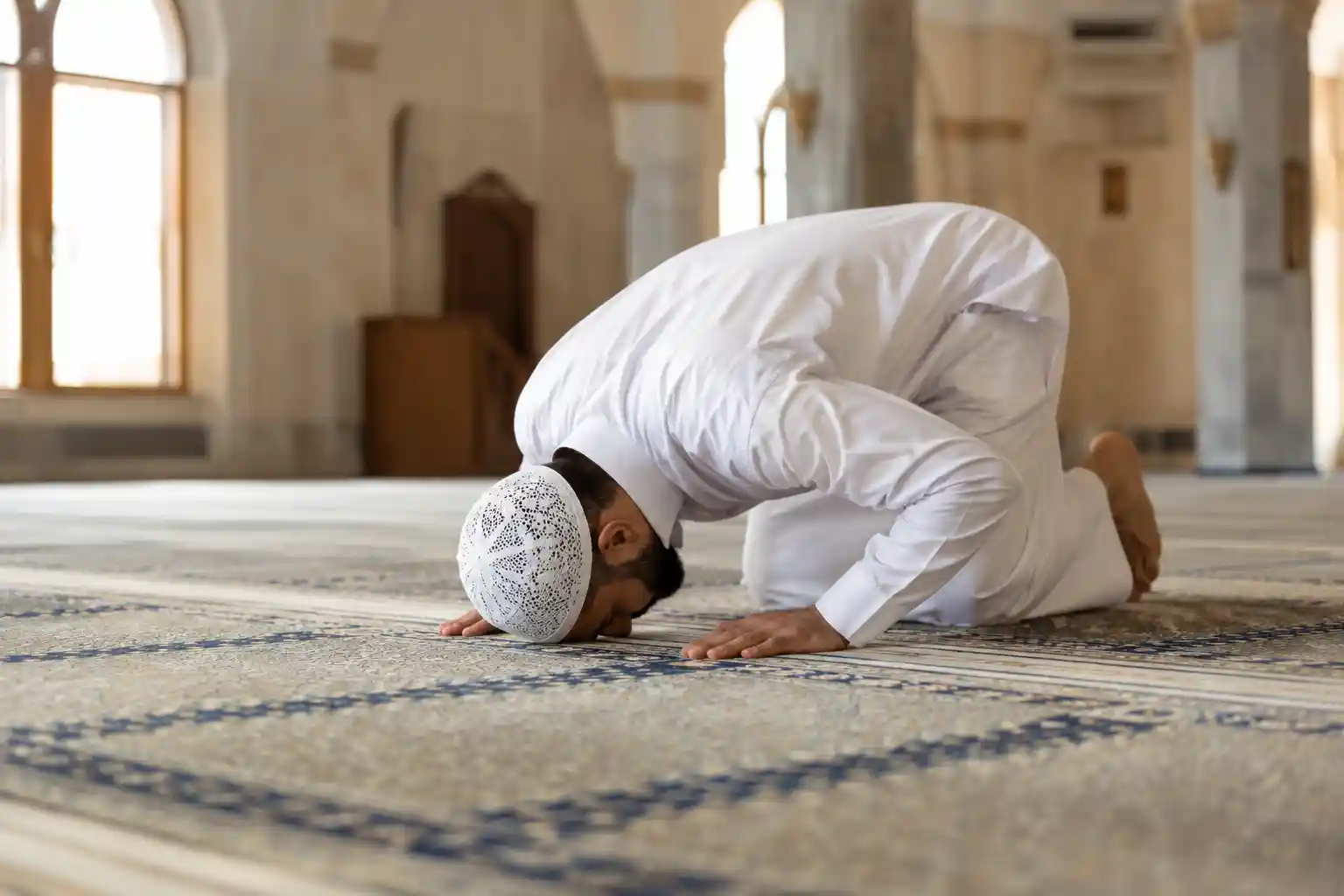
For Muslims, prayer is much more than a religious routine. Salah (Salat) is one of the central acts of worship in Islam and a daily way of remembering Allah, expressing obedience, seeking guidance, and turning back to Him.
Muslims are required to perform five obligatory prayers each day: Fajr, Dhuhr, Asr, Maghrib, and Isha. Each prayer has its own prescribed time and number of obligatory rakats.
The prayers take place at different points of the day—from before sunrise to after nightfall. This gives a Muslim repeated opportunities to pause from everyday responsibilities and remember Allah.
But why five times? Why not once a day, or three times a day? And what does the Qur’an and Sunnah actually say about the obligation?
Featured Snippet Answer: Why Do Muslims Pray Five Times a Day?
Muslims pray five times a day because Allah has commanded Salah as an obligatory act of worship, and the Prophet Muhammad ﷺ taught Muslims how and when to perform the five daily prayers. Salah helps Muslims worship and remember Allah regularly throughout the day and is one of the Five Pillars of Islam.
Why Do Muslims Pray Five Times a Day?
The simplest answer is that Muslims pray five times a day because the five daily prayers are an obligation established through Islamic revelation and the Sunnah of Prophet Muhammad ﷺ.
The Qur’an repeatedly commands believers to establish prayer. For example, Allah says:
“And establish prayer and give zakah and bow with those who bow.”
Surah Al-Baqarah 2:43.
The Qur’an also tells believers to carefully maintain their prayers:
“Maintain with care the [obligatory] prayers and [in particular] the middle prayer…”
Surah Al-Baqarah 2:238.
The exact structure of the five daily prayers—including their times and rakats—is explained through the Sunnah of the Prophet ﷺ.
This distinction is important:
- The Qur’an establishes the command and importance of Salah and gives indications concerning its times.
- Authentic Hadith provide details about the five daily prayers and their prescribed practice.
- Scholars explain additional wisdoms and practical rulings using the Qur’an, Sunnah, and principles of Islamic jurisprudence.
Therefore, Muslims do not independently decide that five prayers are better than one or three. The five obligatory daily prayers are part of the revealed guidance of Islam.
What Are the Five Daily Prayers in Islam?
The five daily prayers are:
| Prayer | Arabic Name | Approximate Time | Number of Obligatory Rakats |
|---|---|---|---|
| Fajr | الفجر | Dawn | 2 |
| Dhuhr | الظهر | After midday | 4 |
| Asr | العصر | Afternoon | 4 |
| Maghrib | المغرب | After sunset | 3 |
| Isha | العشاء | Night | 4 |
Together, these make 17 obligatory rakats each day.
The exact clock time of each prayer is not fixed worldwide. Islamic prayer times change according to location, date, season, latitude, and the calculation method used.
Fajr
Fajr is the dawn prayer. It is performed before sunrise, within its prescribed time.
For many Muslims, Fajr begins the day with worship and remembrance of Allah rather than beginning the morning only with worldly responsibilities.
Dhuhr
Dhuhr is the midday prayer. It occurs after the sun passes its highest point.
It provides a regular opportunity during the working or school day to stop and worship Allah.
Asr
Asr is the afternoon prayer. Its exact starting time has details that differ among schools of Islamic jurisprudence, so Muslims generally follow the timetable based on their local mosque or trusted calculation method.
Maghrib
Maghrib begins after sunset. It marks the transition from daylight into evening.
Isha
Isha is the night prayer. It is performed after the evening twilight has disappeared within its prescribed period.
The Qur’an describes prayer in relation to different portions of the day and night, including the decline of the sun, the darkness of night, and dawn. Surah Al-Isra 17:78 says:
“Establish prayer at the decline of the sun … until the darkness of the night and [also] the Qur’an of dawn.”
This verse indicates the connection between Salah and the different parts of the day.
Is Praying Five Times a Day Commanded by Allah?
Yes. Salah is commanded in the Qur’an, and the five daily obligatory prayers are established through the Qur’an and the authentic Sunnah.
The Qur’an repeatedly instructs believers to establish prayer.
For example, Surah Taha 20:14 says:
“Indeed, I am Allah. There is no deity except Me, so worship Me and establish prayer for My remembrance.”
The verse directly connects prayer with the remembrance of Allah.
Another important passage is Surah Al-Ankabut 29:45, which says that prayer restrains a person from immorality and wrongdoing and that remembering Allah is greater.
The Qur’an also describes prayer at different times of the day. Surah Hud 11:114 says:
“And establish prayer at the two ends of the day and at the approach of the night.”
The verse continues by mentioning that good deeds remove misdeeds.
These passages demonstrate that Salah is not a cultural practice that Muslims simply inherited. It is a fundamental part of Islamic worship.
How Was the Five Daily Prayer Obligation Established?
The detailed account of how the five daily prayers became obligatory is found in authentic Hadith concerning the Isra and Mi’raj, the Night Journey and Ascension of Prophet Muhammad ﷺ.
According to the famous narration in Sahih al-Bukhari, Allah initially prescribed fifty prayers for the Prophet’s Ummah. Prophet Musa (Moses) عليه السلام advised Muhammad ﷺ to ask Allah for a reduction because he believed the community would find fifty difficult.
The Prophet ﷺ returned repeatedly, and the number was eventually reduced to five daily prayers.
The narration then states that Allah declared that these five would carry the reward of fifty, while the obligation remained five.
This account is recorded in Sahih al-Bukhari 349.
This detail comes from Hadith, not from a Qur’anic verse. That distinction is important when explaining the Islamic basis for the five prayers.
The Isra and Mi’raj is therefore highly significant in Islamic tradition because it is associated with the establishment of the five daily prayers.
What Is the Purpose of Salah in Islam?
There are many purposes and spiritual dimensions to Salah. However, Muslims should distinguish between what Allah and His Messenger ﷺ explicitly state and the wisdoms scholars and believers derive from the practice.
1. Obeying Allah
At its foundation, Salah is an act of obedience.
A Muslim prays because Allah has commanded prayer. Worship is not dependent upon whether a person immediately understands every wisdom behind a command.
2. Remembering Allah
One of the clearest purposes explicitly mentioned in the Qur’an is remembrance.
Allah says:
“Establish prayer for My remembrance.”
Surah Taha 20:14.
This makes Salah a recurring reminder of Allah throughout the day.
3. Worshipping Allah
Salah is an act of worship involving the heart, tongue, and body.
A Muslim stands, recites Qur’an, bows, and prostrates before Allah.
4. Developing Taqwa
Taqwa can be understood broadly as being conscious of Allah and living with awareness of one’s accountability before Him.
Regular prayer can help reinforce that awareness because a Muslim repeatedly leaves ordinary activities to stand before Allah.
5. Seeking Guidance
Muslims recite Surah Al-Fatihah during prayer, including the supplication:
“Guide us to the Straight Path.”
Thus every obligatory prayer includes a repeated request for guidance.
6. Showing Gratitude
Prayer provides an opportunity to praise Allah and acknowledge His greatness and blessings.
Gratitude in Islam is not limited to saying “thank you.” It includes worshipping Allah and using blessings in ways that please Him.
7. Seeking Forgiveness
Authentic Hadith describe the five daily prayers as a means through which Allah removes sins.
The Prophet ﷺ compared the five prayers to a river in which a person washes five times each day. Sahih al-Bukhari 528 records this analogy and says that Allah blots out sins through the five prayers.
8. Developing Discipline
Salah has prescribed times. A Muslim therefore has to organize daily activities around those times.
This can cultivate religious discipline, although discipline should be understood as a practical consequence of regular worship rather than presented as the sole reason Allah prescribed five prayers.
9. Maintaining Spiritual Awareness
Human beings become absorbed in work, family, money, school, entertainment, and other responsibilities.
Five daily prayers repeatedly redirect attention toward Allah.
10. Strengthening the Relationship With Allah
Salah gives a Muslim regular moments to stand before Allah, recite His words, praise Him, seek His guidance, and make personal supplications.
For a practicing Muslim, this repeated worship is an important part of living with faith.
Why Five Times Instead of Once a Day?
This is one of the most common questions from people learning about Islam.
The answer is that Muslims do not choose the number five themselves.
The five obligatory prayers are part of the religious guidance established through revelation and the Sunnah.
The Qur’an commands believers to establish and guard their prayers, while authentic Hadith explain the five daily obligation in detail. The account of the Isra and Mi’raj also explains how the obligation was reduced from fifty to five while retaining the reward of fifty.
Muslims can also understand an important practical wisdom in the repeated timing: prayer does not become something remembered only once during the day.
Instead, worship returns at dawn, midday, afternoon, sunset, and night.
But it would be inaccurate to say, without evidence, that Allah specifically chose five only because of a particular worldly or psychological benefit.
A Muslim can recognize wisdom in the practice while still saying: Allah knows best why He prescribed it in exactly this form.
What Are the Five Prayer Times?
The five daily prayers are linked to different periods of the day.
Fajr — Dawn
Fajr takes place before sunrise, beginning with true dawn.
The Qur’an specifically refers to the dawn recitation in Surah Al-Isra 17:78, describing it as witnessed.
Dhuhr — After Midday
Dhuhr begins after the sun has passed its zenith.
Asr — Afternoon
Asr takes place later in the day. Its precise beginning has jurisprudential differences concerning how the shadow of an object is measured.
Maghrib — After Sunset
Maghrib begins after sunset.
Isha — Night
Isha is the night prayer, performed during its prescribed period.
Because sunrise and sunset change throughout the year, prayer times change as well.
For that reason, Muslims generally use a reliable local prayer timetable rather than trying to memorize fixed clock times.
Why Do Muslims Pray at Different Times During the Day?
The five prayers create regular moments of worship throughout the day.
A simple way to understand the rhythm is:
- Fajr: Begin the day with worship.
- Dhuhr: Pause around the middle of the day.
- Asr: Remember Allah during the later part of the day.
- Maghrib: Worship at the transition from day to evening.
- Isha: End the day with night prayer.
This rhythm means Salah is not limited to one particular part of life.
The Qur’an connects prayer with different times of the day and night, including the decline of the sun and dawn.
The spiritual lesson is not that Muslims must escape daily life. Rather, ordinary life is repeatedly interrupted by worship so that Allah remains central to a believer’s life.
What Happens If a Muslim Misses a Prayer?
The answer depends on why the prayer was missed, and Islamic jurisprudence contains important distinctions.
If someone forgets a prayer
There is clear authentic guidance that a person who forgets a prayer should pray it when they remember it.
The Prophet ﷺ said that whoever forgets a prayer should perform it when he remembers it.
This is recorded in Sahih al-Bukhari 597 and Sahih Muslim 684.
If someone sleeps through a prayer
The same principle applies when sleep causes the prayer to be missed: the person should pray it after waking and remembering.
What about deliberately missing prayer?
This is a much more serious matter.
The Qur’an and Sunnah strongly emphasize maintaining Salah. There is also an authentic Hadith in Sahih Muslim 82 concerning abandoning prayer that scholars have discussed extensively.
Scholars differ over some legal details concerning a person who deliberately abandons prayer, including questions about whether missed prayers must be made up and how deliberate abandonment should be legally classified.
Therefore, it is better not to give a blanket ruling for every situation.
A person who has deliberately missed prayers should repent sincerely, seek Allah’s forgiveness, and consult a qualified scholar regarding the applicable ruling and method of making up missed prayers.
Do Muslims Have to Pray Five Times Every Day?
The general Islamic ruling is that the five daily prayers are obligatory for Muslims who are religiously accountable and for whom prayer is due.
There are, however, circumstances in which Islamic law provides exemptions, concessions, or changes in how prayer is performed.
These include matters such as:
- Childhood before religious accountability
- Menstruation
- Postnatal bleeding
- Illness
- Travel
- Certain situations involving fear or inability
The details can differ between schools of Islamic jurisprudence.
For example, illness does not generally mean that prayer simply disappears. Islamic law provides concessions concerning how a person prays according to their ability.
Similarly, travelers may have specific concessions such as shortening certain prayers, with additional jurisprudential details.
These rulings demonstrate an important principle: Salah is obligatory, but Islamic law also recognizes genuine human circumstances.
Do Women Have to Pray Five Times a Day?
Yes. Muslim women who are religiously accountable are generally obligated to perform the five daily prayers when prayer is due.
However, Islamic law gives women a specific exemption from Salah during menstruation and postnatal bleeding.
A woman does not perform the obligatory prayers during menstruation, and authentic Hadith indicate that she is not required to make up those missed prayers afterward.
This is explicitly reported by Aishah رضي الله عنها in Sahih Muslim 335, where she explained that women were instructed to make up missed Ramadan fasts but were not instructed to make up the prayers missed during menstruation.
This is a religious ruling, not a statement that women are less important in Islam.
Do Muslims Pray Five Times Because They Are Forced?
There is an important difference between religious obligation and personal motivation.
Islam teaches that Salah is obligatory. In that sense, it is a duty.
But a practicing Muslim may experience prayer as much more than an obligation. Salah can be an act of love, gratitude, humility, repentance, hope, and devotion.
It is also important to distinguish Islam itself from family or community pressure.
A person may be pressured by family members to pray, but that social pressure should not be confused with the religious purpose of Salah.
For Muslims, the central reason for prayer is worshipping and obeying Allah.
What Are the Spiritual Benefits of Five Daily Prayers?
Islamic sources describe several spiritual benefits of Salah.
Regular remembrance of Allah
The Qur’an explicitly connects prayer with remembering Allah.
Repentance and purification from sins
The Prophet ﷺ compared the five prayers to repeatedly washing in a river and described them as a means by which Allah removes sins.
Humility
Salah includes standing before Allah, bowing, and prostrating.
Gratitude
The prayer includes praise of Allah and recognition of His greatness.
Patience
The Qur’an tells believers to seek help through patience and prayer in Surah Al-Baqarah 2:45.
Discipline
Prayer requires consistency and attention to prescribed times.
Taqwa
Regular worship can reinforce awareness of Allah and accountability.
Community connection
Congregational prayer brings Muslims together in shared worship.
It is important not to turn these spiritual benefits into unsupported medical claims. Islam does not require Muslims to justify Salah through modern scientific studies. Salah is first and foremost an act of worship.
How Does Salah Help Muslims Remember Allah?
The answer is directly found in the Qur’an.
Allah says:
“Establish prayer for My remembrance.”
Surah Taha 20:14.
This is one of the clearest explanations of the spiritual purpose of Salah.
During a normal day, people can become absorbed in work, business, family responsibilities, school, entertainment, and personal concerns.
Salah creates prescribed moments when the believer stops and turns toward Allah.
The Prophet ﷺ also taught that someone who forgets a prayer should pray it when they remember it, again connecting prayer with remembrance. Sahih al-Bukhari 597 records this instruction.
Why Is Salah One of the Most Important Acts of Worship in Islam?
Salah occupies a central position in Islam.
The Prophet Muhammad ﷺ described Islam as being built upon five foundational principles:
- Shahadah — testimony of faith
- Salah — prayer
- Zakat — obligatory charity
- Sawm — fasting Ramadan
- Hajj — pilgrimage to Makkah for those able to perform it
This is recorded in Sahih al-Bukhari 8.
Salah has a particularly distinctive place because it is performed repeatedly every day.
A Muslim may pay Zakat annually if eligible. Hajj is required once in a lifetime for those who are physically and financially able. Ramadan fasting occurs during one month each year.
Salah, however, returns five times each day for the person upon whom it is obligatory.
What Does a Muslim Say During Prayer?
Salah contains both recitation and physical actions.
A beginner may encounter the following elements:
Takbir
The prayer begins with Takbir, declaring Allah’s greatness with Allahu Akbar.
Surah Al-Fatihah
Surah Al-Fatihah is recited in each rakah according to the established Sunnah and jurisprudential details.
Additional Qur’an Recitation
In many prayers, additional Qur’anic verses or a surah are recited.
Ruku
The worshipper bows before Allah.
Sujood
The worshipper prostrates before Allah.
Sujood is one of the most recognizable positions in Salah and represents humility and submission.
Tashahhud
The worshipper sits and recites the prescribed testimony and related supplications.
Salawat
The worshipper sends blessings upon Prophet Muhammad ﷺ.
Salam
The prayer concludes with the prescribed salam.
The exact details can differ slightly among recognized schools of Islamic jurisprudence, but the fundamental structure of Salah is shared across the Muslim world.
Why Do Muslims Face the Kaaba When They Pray?
Muslims face the Kaaba in Makkah when performing Salah. This direction is called the Qiblah.
Facing the Kaaba is an act of obedience and unity.
Muslims do not worship the Kaaba.
The Kaaba is a direction of prayer. The object of worship is Allah alone.
This distinction is especially important for people who are unfamiliar with Islam.
Whether a Muslim is praying in a mosque, home, office, school, airport, or another suitable place, they attempt to face the Qiblah when able.
Why Do Muslims Pray in Congregation?
Congregational prayer is an important part of Muslim community life.
When Muslims pray together, people from different backgrounds stand in the same rows.
There is no requirement that a person’s wealth, occupation, nationality, or social status determine where they stand.
The Qur’an also describes believers bowing together in worship. Surah Al-Baqarah 2:43 says:
“…and bow with those who bow.”
There are differences among Islamic legal schools concerning the precise ruling and level of obligation of congregational prayer for men, so it is better not to claim that every Muslim follows an identical legal position.
For many Muslims, congregation strengthens:
- Unity
- Brotherhood
- Community
- Shared worship
- Mutual support
Can Muslims Pray Anywhere?
Generally, Salah does not require a mosque every time.
The Prophet ﷺ taught that the earth was made a place of prayer for his followers. Sahih al-Bukhari 438 records this principle.
Therefore, Muslims may pray in suitable places such as:
- A mosque
- Home
- Workplace
- School or university
- Hotel
- Airport
- Outdoor locations
- While traveling
The place should meet the relevant Islamic requirements concerning cleanliness and suitability, and particular locations can have their own rulings.
The key point for beginners is that a Muslim does not need to be inside a mosque to perform every daily prayer.
Why Do Muslims Pray Even When They Are Busy?
Because Salah is a religious obligation with prescribed times.
Muslims do not normally treat prayer as something that can always be postponed until they have free time.
Instead, the prayer times become part of the structure of the day.
A person may be working, studying, traveling, caring for children, or managing a business, but prayer remains an important part of their schedule.
This idea can be seen in the Qur’an’s instruction to guard the prayers. Surah Al-Baqarah 2:238 emphasizes maintaining them and standing before Allah with devotion.
Why Do Muslims Pray Before Sunrise and at Night?
Fajr and Isha can seem particularly unusual to someone unfamiliar with Islam.
Why Fajr?
Fajr is the dawn prayer.
It reminds Muslims that worship is not restricted to convenient daytime hours. The Qur’an specifically mentions the dawn recitation in 17:78.
Why Isha?
Isha takes place at night and provides another prescribed opportunity for worship.
It is not necessary to claim that Fajr exists because it provides a specific health benefit or that Isha produces a particular scientific effect. Such claims are not needed to explain Salah.
The Islamic reason is simpler: Allah has prescribed these prayers as acts of worship.
Related Quran & Islamic Resources
- Surah Yaseen PDF in English, Hindi & Arabic
- Surah Ikhlas PDF in English, Hindi, Urdu & Arabic
- Surah Adiyat PDF Download
- Surah Mulk PDF
- Surah Rahman PDF
- Ayatul Kursi PDF
- How to Perform Wudu Step by Step
- How to Perform Ghusl Step by Step
- Namaz Guides
Common Questions About the Five Daily Prayers
1. Why do Muslims pray five times a day?
Muslims pray five times a day because the five obligatory daily prayers are part of Islamic revelation and the Sunnah of Prophet Muhammad ﷺ. Salah is an obligation and a central act of worship. It also gives Muslims regular opportunities to remember Allah throughout the day.
2. What are the five daily prayers in Islam?
The five prayers are Fajr, Dhuhr, Asr, Maghrib, and Isha. Fajr is at dawn, Dhuhr after midday, Asr in the afternoon, Maghrib after sunset, and Isha at night. Their exact clock times change according to location and season.
3. Is praying five times a day mandatory?
Yes. The five daily obligatory prayers are required of Muslims who are religiously accountable and for whom prayer is due. Islamic law also recognizes circumstances such as menstruation, illness, travel, and other situations where concessions or exemptions may apply.
4. Why are there five prayers instead of three?
Muslims do not choose the number of obligatory prayers. According to the authentic Hadith concerning the Isra and Mi’raj, fifty prayers were initially prescribed and the obligation was eventually reduced to five, while the reward remained equivalent to fifty. This account is recorded in Sahih al-Bukhari 349.
5. What time do Muslims pray?
Muslims pray at prescribed times connected to the movement of the sun: dawn, after midday, afternoon, sunset, and night. Because daylight changes throughout the year and differs by location, there is no single worldwide clock time for each prayer.
6. How many rakats are in the five daily prayers?
The obligatory rakats are 2 for Fajr, 4 for Dhuhr, 4 for Asr, 3 for Maghrib, and 4 for Isha, totaling 17 obligatory rakats. Additional Sunnah and voluntary prayers may be performed beyond these obligatory rakats.
7. What happens if a Muslim misses a prayer?
If someone misses a prayer because they forgot or slept through it, authentic Hadith instruct them to pray it when they remember. Deliberately abandoning prayer is a much more serious matter, and scholars have differences regarding some legal details.
8. Can Muslims pray anywhere?
Yes, Salah can generally be performed in many suitable places. A mosque is not required for every prayer. Muslims can pray at home, work, school, while traveling, or in another clean and appropriate place, subject to Islamic requirements.
9. Why do Muslims face the Kaaba?
Muslims face the Kaaba because Allah prescribed the Qiblah as the direction of prayer. Facing the Kaaba creates unity among Muslims worldwide. Muslims do not worship the Kaaba; they worship Allah.
10. Why do Muslims pray toward Makkah?
Makkah contains the Kaaba, which is the Qiblah for Muslims. Muslims around the world turn toward it during Salah as an act of obedience and unity. The direction itself is not worshipped.
11. Do women pray five times a day?
Yes. Muslim women who are religiously accountable perform the five daily prayers when prayer is required. During menstruation and postnatal bleeding, women do not perform Salah, and authentic Hadith indicate that those missed prayers are not made up afterward.
12. Do children have to pray five times a day?
Children are not treated as religiously accountable in the same way as adults before reaching accountability. Islamic teachings encourage parents to teach children Salah from a young age. A well-known report in Sunan Abi Dawud 495 instructs parents to command children to pray at seven.
13. Why is Salah important in Islam?
Salah is one of the Five Pillars of Islam and is an obligatory act of worship. It provides regular opportunities to remember Allah, worship Him, seek guidance, express gratitude, and ask for forgiveness. The Prophet ﷺ placed prayer at the center of Islamic practice.
14. What is the difference between Salah and Dua?
Salah refers to the prescribed ritual prayer with specific times, actions, recitations, and conditions. Dua means supplication or calling upon Allah. Dua can be made at many times, while the five obligatory Salah have specific prescribed times and forms.
15. Can a Muslim pray more than five times a day?
Yes. Five are the obligatory daily prayers. Muslims can also perform voluntary prayers, such as Sunnah prayers, Tahajjud, and other nafl prayers. The Qur’an itself refers to additional night prayer as extra worship in Surah Al-Isra 17:79.
16. Why do Muslims pray before sunrise?
Fajr is prescribed during the dawn period before sunrise. It is one of the five obligatory prayers. The Qur’an specifically refers to the dawn recitation as witnessed in Surah Al-Isra 17:78.
17. Why do Muslims pray after sunset?
Maghrib is the obligatory prayer that begins after sunset. It marks one of the prescribed daily transitions for Salah. Muslims worship Allah at this time because the prayer has been legislated for this part of the day.
18. Why do Muslims pray at night?
Isha is the obligatory night prayer. Its prescribed time extends into the night, subject to detailed jurisprudential rulings. Night prayer also reminds Muslims that worship is part of life even after the day’s ordinary activities have ended.
19. What does Salah mean?
Salah, commonly translated as prayer, refers to the prescribed Islamic ritual prayer. It includes specific recitations, movements, postures, and times. In everyday English, “Muslim prayer” is often used to describe Salah.
20. What are the benefits of praying five times a day?
Islamic sources describe benefits including remembrance of Allah, spiritual purification, humility, repentance, and obedience. The Prophet ﷺ compared the five prayers to repeatedly washing in a river and explained that Allah removes sins through them.
The Five Daily Prayers: A Simple Summary
For someone new to Islam, the five prayers can be remembered like this:
| Prayer | Part of Day | Obligatory Rakats |
|---|---|---|
| Fajr | Dawn | 2 |
| Dhuhr | After midday | 4 |
| Asr | Afternoon | 4 |
| Maghrib | After sunset | 3 |
| Isha | Night | 4 |
The purpose is not simply to complete a checklist.
Salah is a repeated act of worship that keeps a Muslim connected to Allah throughout the day.
❤️ Enjoying Our Free Islamic Resources?
If this article has benefited you, please consider supporting OnlyIslamWay. Your contribution helps us continue providing free Islamic educational resources for Muslims worldwide.
❤️ Donate with PayPalFinal Thoughts: Why Do Muslims Pray Five Times a Day?
So, why do Muslims pray five times a day?
The primary answer is straightforward: because Allah has commanded Salah, and the Sunnah of Prophet Muhammad ﷺ establishes the five daily obligatory prayers.
But the experience of Salah goes beyond obligation.
Through Fajr, Dhuhr, Asr, Maghrib, and Isha, Muslims repeatedly return to worship. They stand before Allah, recite His words, bow, prostrate, praise Him, seek guidance, ask for forgiveness, and remember Him.
The Qur’an says:
“Establish prayer for My remembrance.”
Surah Taha 20:14.
The five daily prayers therefore become a rhythm of worship throughout a Muslim’s life.
They remind believers that work, family, money, education, and other responsibilities are important—but Allah remains at the center of their faith.
For someone learning about Islam, perhaps the most useful way to understand Salah is not simply to ask, “Why five?”
It is also to ask:
“What does it mean for a person to stop five times a day and consciously turn toward their Creator?”
That is at the heart of understanding the importance of Salah in Islam.