
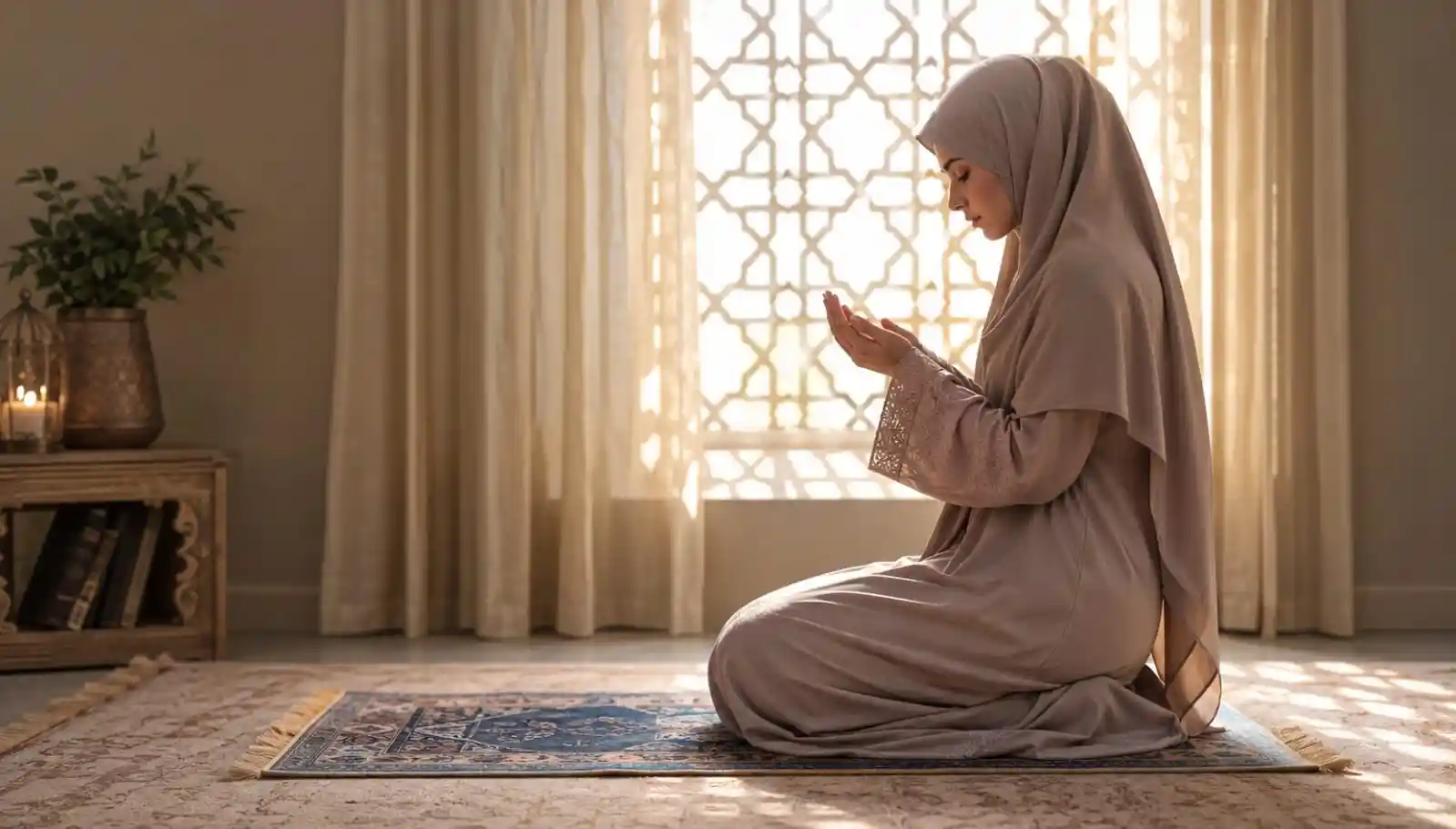
Salah is one of the most important acts of worship in Islam. It is a direct connection between a believer and Allah. For Muslim women around the world, learning how to pray correctly is an essential part of strengthening faith and living according to Islamic teachings.
Whether you are a new Muslim, returning to your faith, or simply looking to improve your worship, this Women’s Prayer Guide in Islam will help you understand the prayer process step by step.
In this beginner-friendly guide, you will learn what Salah is, how women pray in Islam, how to perform Wudu, the prayer steps for Muslim women, common mistakes to avoid, and practical tips to improve your concentration during prayer.
✔ Easy to read | ✔ Printable | ✔ Step-by-step guide
What Is Salah in Islam?
Salah is the obligatory Islamic prayer performed five times each day by Muslims. It is the second pillar of Islam after the declaration of faith (Shahadah).
The five daily prayers are:
- Fajr (before sunrise)
- Dhuhr (afternoon)
- Asr (late afternoon)
- Maghrib (after sunset)
- Isha (night)
Salah helps Muslims remember Allah throughout the day, seek guidance, and maintain spiritual discipline.
Allah says in the Quran:
“Indeed, prayer prohibits immorality and wrongdoing.” (Quran 29:45)
Regular prayer strengthens faith, brings peace to the heart, and keeps believers connected to their Creator.
Build a Stronger Connection with Allah Every Day
Looking to organize your day according to Islamic teachings? Our Muslim Daily Routine Guide for a Balanced Islamic Life provides practical tips for managing Salah, Quran reading, Dhikr, work, family responsibilities, and self-care while staying connected to Allah throughout the day.
Read the Complete Muslim Daily Routine Guide →Is Women’s Prayer Different From Men’s Prayer?
One of the most common questions is whether women pray differently from men.
Most scholars agree that the basic method of Salah is the same for both men and women because the Prophet Muhammad (peace be upon him) said:
“Pray as you have seen me praying.”
Some scholars mention minor differences in posture related to modesty, while others state that the prayer movements remain generally the same.
For beginners, the most important goal is learning the correct prayer method and performing Salah sincerely according to the teachings of Islam.
Conditions Before Prayer
Before beginning Salah, several conditions must be fulfilled.
Purity (Wudu)
A Muslim must be in a state of ritual purity by performing Wudu.
Clean Clothing
Your clothing should be clean and free from impurities.
Prayer Area
The place where you pray should be clean.
Facing the Qiblah
Face the direction of the Kaaba in Makkah.
Covering the Awrah
For women, the entire body should be covered except the face and hands according to the majority of scholars.
Clothing should be:
- Loose
- Clean
- Modest
- Non-transparent
How to Perform Wudu Before Salah
Wudu is the purification process before prayer.
Follow these steps:
Step 1
Make the intention for Wudu.
Step 2
Say “Bismillah.”
Step 3
Wash both hands three times.
Step 4
Rinse the mouth three times.
Step 5
Clean the nose three times.
Step 6
Wash the face three times.
Step 7
Wash the right arm, then the left arm up to the elbows three times.
Step 8
Wipe over the head once.
Step 9
Wipe the ears.
Step 10
Wash the feet up to the ankles three times.
Common Wudu Mistakes
- Missing parts of the face
- Forgetting the ankles
- Rushing through Wudu
- Using too little water
Take your time and ensure each part is washed properly.
💧 Learn Wudu Step by Step
Want to learn the correct way to perform Wudu before Salah? Follow our complete beginner-friendly guide with easy steps, pictures, duas, and important Sunnah tips.
Read Complete Wudu GuideWomen’s Prayer Guide in Islam: Step-by-Step Salah
This section explains Salah for women step by step.
Step 1: Make the Intention (Niyyah)
The intention is made in the heart.
You do not need to say it aloud.
Know which prayer you are performing.
Example:
“I intend to pray Fajr for Allah.”
Step 2: Takbir (Allahu Akbar)
Raise your hands and say:
Allahu Akbar
(Allah is the Greatest)
Then place your hands comfortably while standing.
Step 3: Recite Surah Al-Fatihah
Recite Surah Al-Fatihah completely.
This chapter is required in every Rak’ah.
Step 4: Recite Another Short Surah
After Al-Fatihah, recite another chapter such as:
- Surah Ikhlas
- Surah Falaq
- Surah Nas
- Surah Kawthar
Step 5: Ruku (Bowing)
Bow down and place your hands on your knees.
Say three times:
Subhana Rabbiyal Azeem
(Glory is to my Lord, the Most Great)
Step 6: Standing After Ruku
Rise and say:
Sami Allahu liman hamidah
Then say:
Rabbana wa lakal hamd
Stand straight before continuing.
Step 7: Sujood (Prostration)
Go into prostration.
Place the following on the ground:
- Forehead
- Nose
- Both hands
- Knees
- Toes
Say three times:
Subhana Rabbiyal A’la
(Glory is to my Lord, the Most High)
Step 8: Sitting Between Two Sujoods
Sit briefly and say:
Rabbighfir li
(My Lord, forgive me)
Step 9: Second Sujood
Perform another prostration and repeat:
Subhana Rabbiyal A’la
Step 10: Complete the Rak’ah
Stand up and repeat the prayer cycle.
Each cycle is called a Rak’ah.
The number of Rak’ahs depends on the prayer being performed.
Step 11: Tashahhud
When sitting in the final Rak’ah, recite the Tashahhud.
Then send blessings upon Prophet Muhammad (peace be upon him).
Step 12: Tasleem
End the prayer by turning your head to the right and saying:
Assalamu Alaikum wa Rahmatullah
Then to the left:
Assalamu Alaikum wa Rahmatullah
The prayer is now complete.
How Many Rakats Are in Each Daily Prayer?
| Prayer | Sunnah Before | Fard | Sunnah After | Witr |
|---|---|---|---|---|
| Fajr | 2 | 2 | — | — |
| Dhuhr | 4 | 4 | 2 | — |
| Asr | 4 (recommended) | 4 | — | — |
| Maghrib | — | 3 | 2 | — |
| Isha | 4 (recommended) | 4 | 2 | 3 |
Women perform the same number of Rak’ahs as men.
Common Mistakes Women Make During Salah
Rushing the Prayer
Take your time during each position.
Incorrect Pronunciation
Learn Surah Al-Fatihah carefully and improve gradually.
Lack of Concentration
Focus on the meaning of what you are reciting.
Missing Prayer Times
Use prayer apps or alarms to stay consistent.
How to Read Arabic for Beginners
Learning to read Arabic is the first step toward understanding the Quran, daily duas, and Salah recitations. This beginner-friendly guide teaches the Arabic alphabet, letter pronunciation, joining rules, harakat (vowel marks), and simple reading exercises to help you build confidence quickly. Whether you are a new Muslim or starting your Arabic journey, this guide makes learning easy and practical.
Read Complete Arabic Learning Guide →Tips to Improve Concentration in Prayer
Developing Khushu (humility and focus) takes practice.
Helpful tips include:
- Pray in a quiet place
- Understand the meanings of recitations
- Turn off distractions
- Make sincere dua before prayer
- Pray on time
- Imagine standing before Allah
Even small improvements can make a big difference.
Women’s Prayer During Menstruation
Islam provides ease and mercy for women during menstruation.
During a menstrual period:
- Salah is not performed
- Fasting is postponed and made up later
- Missed prayers are not made up afterward
This ruling is based on authentic Islamic teachings and demonstrates Allah’s mercy toward women.
When the menstrual cycle ends and purification is completed, regular prayer resumes.
Benefits of Praying Salah Regularly
Spiritual Benefits
- Strengthens faith
- Increases closeness to Allah
- Brings blessings into life
Mental Peace
- Reduces stress
- Creates inner calm
- Encourages gratitude
Discipline
- Builds consistency
- Improves time management
- Develops self-control
Regular prayer positively impacts every area of life.
Download Women’s Prayer Guide PDF
Want a printable version of this Muslim women’s prayer guide?
Download our Women’s Salah Guide PDF and keep it on your phone, tablet, or print it for daily practice.
The guide includes:
- Complete Wudu instructions
- Salah steps for women
- Essential Arabic recitations
- Prayer checklist
- Daily prayer chart
Save it for easy reference and share it with family and friends.
📥 Download Women’s Prayer Guide PDF
Get the complete Women’s Prayer Guide in PDF format for free.
Download PDFFrequently Asked Questions
Can women pray at home?
Yes. Women may pray at home, and many scholars encourage home prayer due to comfort and convenience.
Can women pray in a mosque?
Yes. Women are permitted to pray in mosques while observing Islamic guidelines.
How many Rakats should women pray?
Women pray the same number of Rak’ahs as men for each daily prayer.
Can women read Salah from a paper?
Beginners may use written guides while learning, especially when memorization is still in progress.
Can women pray while sitting?
Yes. If a woman is unable to stand because of illness or physical limitations, she may pray sitting down.
What should women wear during prayer?
Women should wear loose, modest, and non-transparent clothing that covers the body appropriately.
What happens if a prayer is missed?
If missed unintentionally, the prayer should be performed as soon as remembered.
Can women lead prayer?
Women may lead other women in prayer according to many scholars. Mixed-gender congregational leadership has differing scholarly opinions.
Conclusion
Learning Salah is one of the most rewarding journeys a Muslim woman can take. Prayer is not simply a daily obligation—it is a beautiful conversation with Allah that brings peace, guidance, and blessings into everyday life.
This Women’s Prayer Guide in Islam has covered the essential steps, from Wudu to Tasleem, along with practical advice for improving focus and consistency.
Remember that every expert was once a beginner. Start with sincerity, practice regularly, and continue learning.
May Allah make your prayers easy, accepted, and a source of light in this life and the Hereafter.
Don’t forget to download the Women’s Salah Guide PDF and keep it as your daily prayer companion.
❤️ Enjoying Our Free Islamic Resources?
If this article has benefited you, please consider supporting OnlyIslamWay. Your contribution helps us continue providing free Islamic educational resources for Muslims worldwide.
❤️ Donate with PayPal