
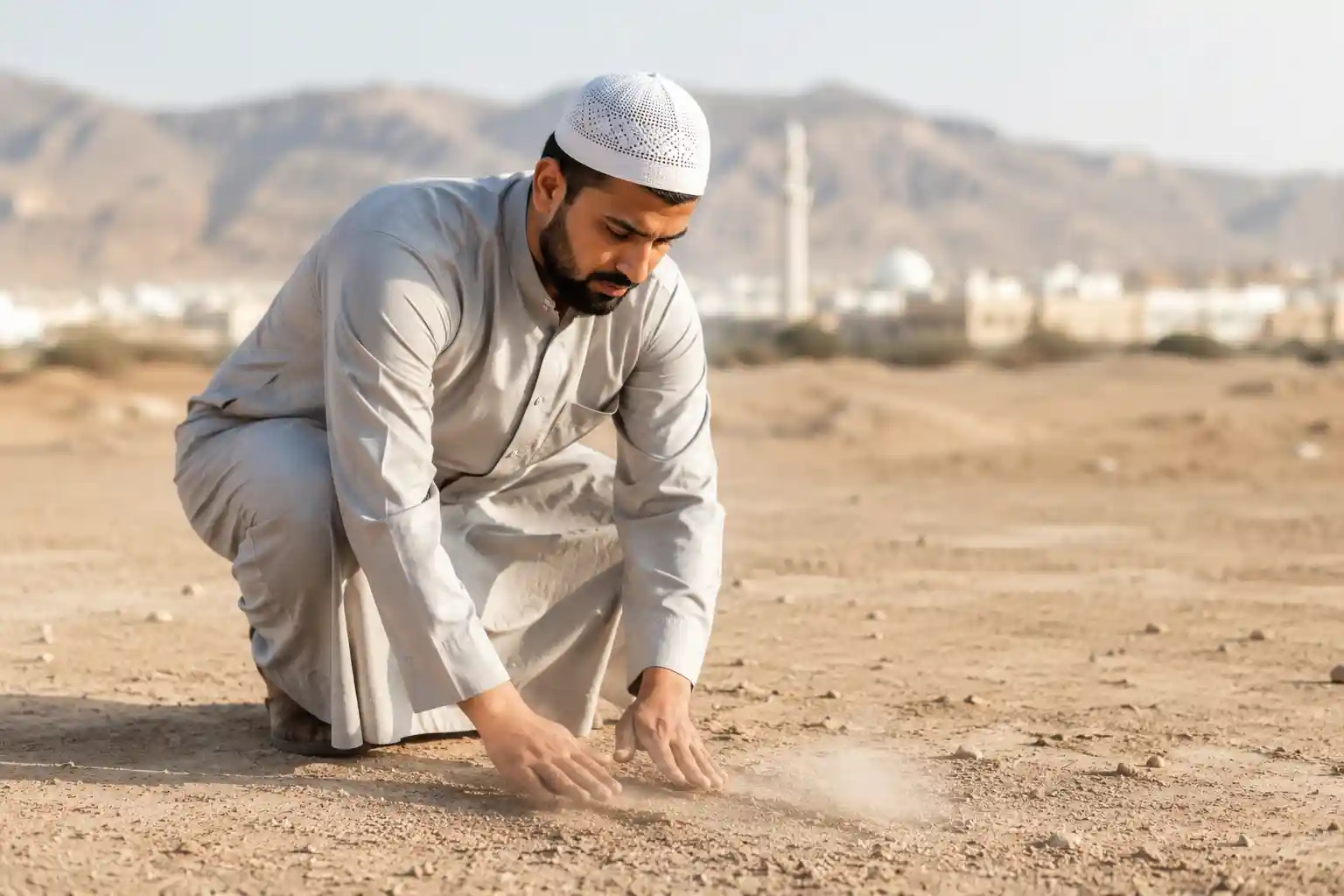
How to Perform Tayammum is an important topic every Muslim should learn. Islam is a religion of mercy and ease. Allah does not want hardship for His servants. Normally, Muslims purify themselves with Wudu or Ghusl before worship. However, there are times when water is unavailable or using it could cause harm.
In these situations, Allah has permitted Tayammum, also known as dry ablution in Islam. It is a beautiful alternative that allows Muslims to continue praying and worshipping without unnecessary difficulty.
Whether you are a new Muslim, a beginner, a traveler, or someone learning Islamic purification, this complete guide explains everything in simple English according to the Quran and authentic Sunnah.
✔ Easy to read | ✔ Printable | ✔ Step-by-step guide
What is Tayammum?
Definition
Tayammum is a form of Islamic purification performed with clean natural earth instead of water when water cannot be used.
Meaning
The Arabic word “Tayammum” means to aim or intend. In Islamic law, it refers to using clean earth to purify oneself before worship.
Importance in Islam
Tayammum shows that Allah’s religion is based on mercy and ease.
It allows Muslims to:
- Continue praying
- Maintain purification
- Avoid hardship
- Follow Allah’s command even during difficult situations
💧 Learn Wudu Step by Step
Want to learn the correct way to perform Wudu before Salah? Follow our complete beginner-friendly guide with easy steps, pictures, duas, and important Sunnah tips.
Read Complete Wudu GuideQuranic Evidence for Tayammum
Allah says in Surah An-Nisa (4:43):
“…And if you do not find water, then perform Tayammum with clean earth and wipe over your faces and hands…”
Surah Al-Ma’idah (5:6)
Allah says:
“…If you cannot find water, then seek clean earth and wipe your faces and hands with it. Allah does not intend to make difficulty for you, but He intends to purify you and complete His favor upon you.”
These verses clearly establish Tayammum as a valid form of purification.
Authentic Hadith About Tayammum
The Prophet ﷺ said:
“The earth has been made for me a place of prayer and a means of purification.”
Reference: Sahih al-Bukhari & Sahih Muslim
Another narration reports that the Prophet ﷺ demonstrated Tayammum by striking the earth once and wiping the face and hands.
These authentic narrations explain the correct Tayammum method according to the Sunnah.
When is Tayammum Allowed?
Islam allows Tayammum in several situations.
1. No Water Available
If no water can be found after making a reasonable effort.
2. Illness
If using water may worsen an illness.
3. Medical Condition
People recovering from surgery, burns, or serious wounds may perform Tayammum if water would be harmful.
4. Fear of Harm
When trustworthy medical advice indicates that water use is dangerous.
5. Extremely Cold Weather
If heating water is impossible and using cold water may seriously harm health.
6. During Travel
Travelers may use Tayammum if water is unavailable or cannot reasonably be accessed.
7. Emergency Situations
Natural disasters, war zones, or other emergencies where water cannot safely be obtained.
Conditions for Tayammum
For Tayammum to be valid:
- Islam
- Sound intention (Niyyah)
- A valid reason for not using water
- Clean natural earth or similar material
- Removal of visible impurities from the body if possible
- Performing Tayammum before Salah when purification is required
Ready to Learn How to Pray Salah?
Now that you’re learning how to read Arabic, the next important step is learning how to perform Salah correctly. Follow our complete beginner-friendly guide that explains every prayer step with easy instructions and illustrations.
📖 How to Pray Salah Step by Step (Complete Beginner’s Guide)Materials Allowed for Tayammum
Islam permits Tayammum using natural materials.
Allowed
- Clean earth
- Dust
- Natural soil
- Sand
- Stone
- Rock
- Clay
- Dust-covered natural surfaces
Not Allowed
- Carpet
- Plastic
- Painted surfaces without natural dust
- Glass
- Metal
- Artificial materials
- Dirty or impure surfaces
How to Perform Tayammum Step by Step
If you are wondering how to perform Tayammum step by step, follow the authentic Sunnah.
Step 1: Make Intention (Niyyah)
Silently intend in your heart that you are performing Tayammum for purification before worship.
No verbal statement is required.
Step 2: Say Bismillah
Begin by saying:
Bismillah
Although scholars differ on its obligation, saying it follows the Sunnah.
Step 3: Strike Clean Earth Once
Lightly place both palms on clean earth one time.
There is no need to strike forcefully.
Step 4: Blow Off Excess Dust
If excessive dust remains on your hands, gently blow it away.
Step 5: Wipe the Face
Use both hands to wipe the entire face once.
Cover the forehead, cheeks, nose, chin, and sides of the face.
Step 6: Wipe Both Hands
According to authentic narrations, wipe both hands once.
Many scholars describe wiping the hands up to the wrists based on authentic reports, while some jurists recommend more. Following the authentic Sunnah as described in the hadith is sufficient.
Step 7: Complete Tayammum
Your Tayammum is complete.
You may now pray Salah or perform other acts of worship requiring purification.
Tayammum Checklist
✅ Have a valid reason not to use water
✅ Make Niyyah
✅ Say Bismillah
✅ Use clean natural earth
✅ Strike once
✅ Remove extra dust
✅ Wipe entire face
✅ Wipe both hands
✅ Pray your Salah
Common Mistakes During Tayammum
Avoid these common beginner mistakes:
- Performing Tayammum without a valid excuse
- Using dirty surfaces
- Forgetting intention
- Striking multiple times unnecessarily
- Wiping incorrectly
- Missing parts of the face
- Using artificial materials
- Thinking Tayammum is always better than Wudu
- Delaying prayer without reason
- Ignoring authentic Sunnah
- Believing dust must be excessive
- Continuing Tayammum after water becomes available without a valid excuse
Things That Break Tayammum
Tayammum becomes invalid if:
- Anything that breaks Wudu occurs
- Water becomes available before prayer when the excuse no longer exists
- The illness preventing water use ends
- A state requiring Ghusl occurs (unless Tayammum was performed specifically for that valid reason)
Tayammum vs Wudu
| Feature | Tayammum | Wudu |
|---|---|---|
| Water Required | No | Yes |
| Material Used | Clean earth | Water |
| Purpose | Purification | Purification |
| When Used | Valid excuse | Normal circumstances |
| Method | Wipe face and hands | Wash prescribed body parts |
| Validity | Temporary substitute | Standard purification |
Can Tayammum Replace Ghusl?
Yes.
If someone is in a state requiring Ghusl (such as Janabah) and cannot use water due to a valid Islamic reason, Tayammum may temporarily replace Ghusl.
Once water becomes available or the excuse ends, the required Ghusl should be performed before future acts that require it.
This ruling is supported by the Quran and authentic Sunnah and is discussed by classical and contemporary scholars.
Can You Pray Multiple Salah with One Tayammum?
Most contemporary scholars state that if Tayammum remains valid and nothing invalidates it, a person may pray multiple obligatory and voluntary prayers with the same Tayammum until it is broken or the excuse ends.
Some schools of Islamic law have more restrictive opinions. If you follow a particular madhhab, consult a qualified scholar for guidance.
Benefits of Tayammum
Tayammum offers many spiritual and practical benefits.
Spiritual Benefits
- Shows obedience to Allah
- Maintains purity
- Enables regular Salah
- Demonstrates Islam’s mercy
- Strengthens faith
Practical Benefits
- Helpful while traveling
- Useful during illness
- Makes worship easier
- Prevents hardship
- Accessible almost anywhere
Frequently Asked Questions
1. Can I perform Tayammum on a wall?
Yes, if the wall has clean natural dust or earth on it. A painted or polished wall without natural dust generally does not qualify.
2. Can Tayammum be done with sand?
Yes. Clean natural sand is acceptable.
3. Can children perform Tayammum?
Yes, if they have a valid reason and are learning prayer.
4. Is Tayammum valid for Janabah?
Yes, when Ghusl cannot be performed for a valid Islamic reason.
5. Can I perform Tayammum while traveling?
Yes. Travelers may perform Tayammum if water is unavailable or cannot reasonably be used.
6. Does Tayammum replace Wudu?
Temporarily, yes, when the conditions for Tayammum are met.
7. How long is Tayammum valid?
Until it is invalidated or the reason permitting Tayammum no longer exists.
8. Can I use a brick or stone?
Yes, if it is made from natural earth and is clean.
9. What if water becomes available?
Use water for purification when you are able and the excuse has ended.
10. Can I perform Tayammum inside my house?
Yes, if suitable natural dust or earth is available and there is a valid reason not to use water.
11. Is one strike enough?
Yes. Authentic hadith indicate that one strike is sufficient.
12. Can Tayammum be performed before every Salah?
Yes, if needed and the conditions continue to exist.
13. Can I make Tayammum before reading the Quran?
If purification is required and water cannot be used for a valid reason, Tayammum may be performed.
14. Is Tayammum easier than Wudu?
It is simpler in method but should only be used when Islam permits it.
15. Is Tayammum accepted by Allah?
Yes. Allah Himself legislated Tayammum in the Quran as a mercy for believers.
Conclusion
Learning How to Perform Tayammum is essential for every Muslim. It reflects Allah’s mercy and ensures that believers can continue worship even when water cannot be used. By following the guidance of the Quran and the authentic Sunnah, you can perform Tayammum correctly and confidently.
Remember that Tayammum is not a replacement for Wudu or Ghusl under normal circumstances. It is a concession granted by Allah during genuine hardship. Whenever water becomes safely available, return to the usual method of purification.
May Allah grant us correct understanding, accept our worship, and make it easy for us to follow the authentic Sunnah in every aspect of our lives. Ameen.
❤️ Enjoying Our Free Islamic Resources?
If this article has benefited you, please consider supporting OnlyIslamWay. Your contribution helps us continue providing free Islamic educational resources for Muslims worldwide.
❤️ Donate with PayPal