
Disclosure: Some links on this page may be affiliate links. If you purchase through an affiliate link, we may earn a small commission at no additional cost to you. This helps support OnlyIslamWay and allows us to continue providing free Islamic resources.
Choosing the Best Quran for Kids is not simply about finding a book with colorful pages or a low price. The right choice depends on a child’s age, Arabic reading ability, attention span, learning goals, and whether they need translation, transliteration, Tajweed guidance, or additional explanations.
A young child who is just learning Arabic letters may need a very different resource from a 10-year-old who can already read the Quran but wants to understand its meaning. Likewise, a teenager practicing Tajweed may benefit more from a color-coded Mushaf than from an illustrated children’s learning book.
Parents should also distinguish between a Quran, a Quran translation, a children’s tafsir, and a Quran-learning book. Some child-friendly resources contain the Arabic Quran alongside explanations or translation, while others teach selected Surahs or their meanings rather than presenting the complete Mushaf.
In this guide, we compare several real, verifiable children’s Quran resources and explain what each may be best suited for. Product details are based on publisher or established bookseller information rather than personal testing.
What Should Parents Look for in a Quran for Kids?
Before buying a best Quran book for kids, consider these features:
- Clear Arabic text: Children need Arabic that is easy to distinguish.
- Appropriate font size: Larger, uncluttered text can be easier for beginning readers.
- Easy layout: Plenty of visual space can reduce confusion.
- Transliteration: Can help beginners with pronunciation, but should support—not replace—Arabic reading.
- English translation: Useful for English-speaking Muslim families who want children to understand meaning.
- Tajweed/color coding: Helpful for learners beginning to recognize recitation rules.
- Durable binding: Hardcover or strong construction can be useful for frequent family use.
- Suitable size: A large page may be easier to read, while a smaller Mushaf is easier to carry.
- Age appropriateness: A preschooler and teenager have very different learning needs.
- Educational features: Illustrations, explanations, glossaries, questions, and learning points can improve engagement.
- Portability: Consider whether the Quran will mainly stay at home, travel to class, or be used during family trips.
Best Quran for Kids: Top Picks
The products below are not presented as a universal ranking. They are selected for different learning situations, because the best Quran for children depends heavily on what the child actually needs.
| Product | Best For | Translation | Transliteration | Tajweed/Color Coding | Recommended Age | Format |
|---|---|---|---|---|---|---|
| The Clear Quran for Kids – Vol. 1 | Understanding Quran with child-friendly explanations | English + Arabic | Not listed | Not a primary feature | Elementary school / 7+ | Hardcover |
| The Clear Quran for Kids – Vol. 2 | Older children’s Quran understanding | English + Arabic | Not listed | Not a primary feature | 7+ | Hardcover |
| The Clear Quran for Kids – Vol. 3 | Studying Surahs with context | English + Arabic | Not listed | Not a primary feature | 7+ | Hardcover |
| The Clear Quran for Kids – Vol. 4 | Short Surahs and memorization-focused learning | English + Arabic | Not listed | Not a primary feature | 7+ | Hardcover |
| My First Quran with Pictures – Part 1 | Younger children learning Juz Amma meanings | English + Arabic | Not listed | No | About 5–10 | Paperback |
| My First Quran with Pictures – Part 2 | Continuing Juz Amma learning | English + Arabic | Not listed | No | About 9–10+ | Paperback |
| My First Quran Storybook | Quran stories and early engagement | English | No | No | 6–12 | Hardcover |
| Juz ‘Amma Primer – Color Codes for Tajweed | Beginning Tajweed practice | Arabic + English rules | No | Yes | Young learners | Large-format edition |
1. The Clear Quran for Kids – Volume 1
Best For
Best for children who need English explanations and structured Quran learning.
Key Features
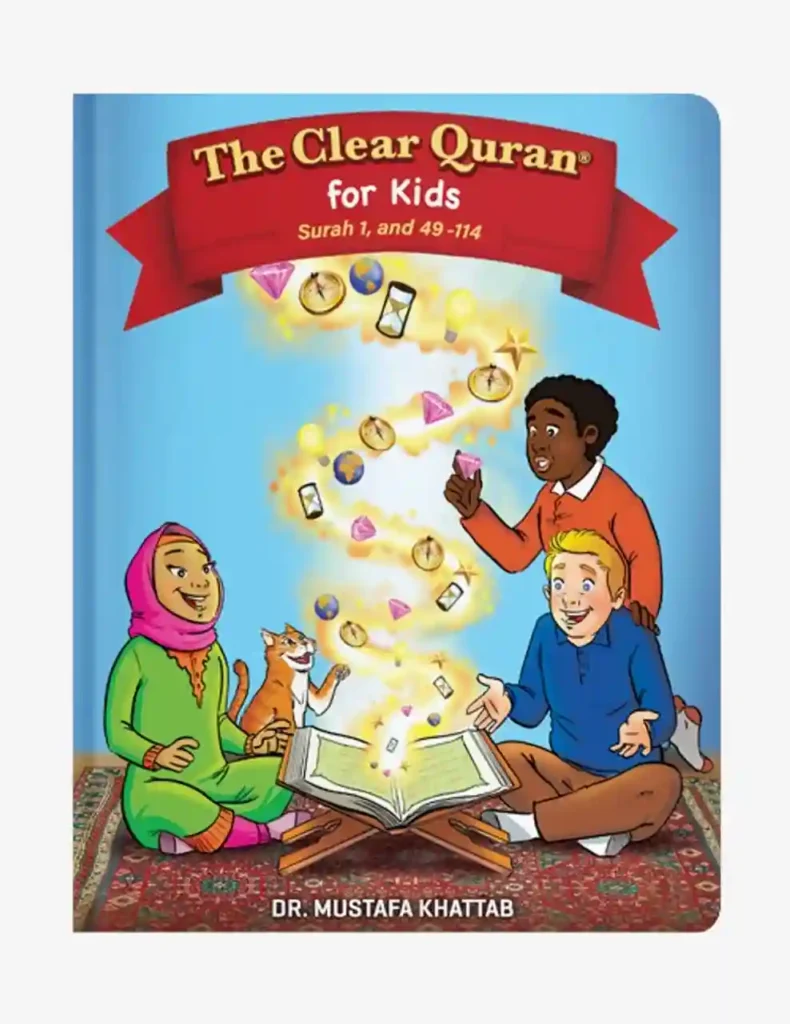
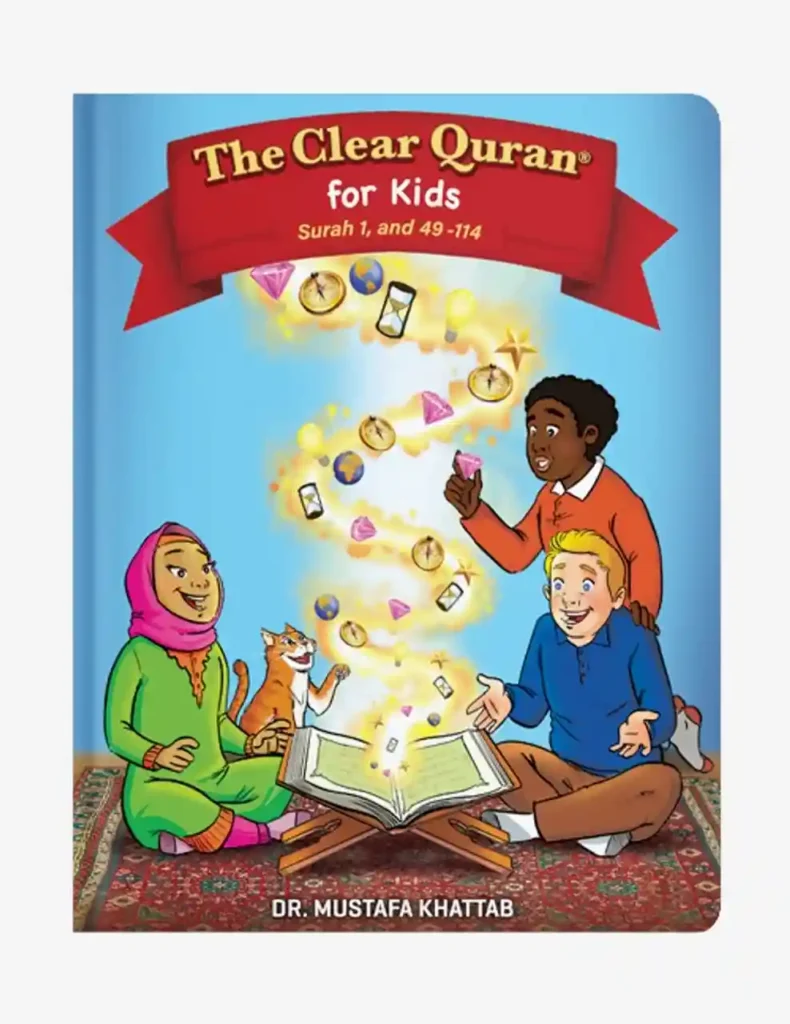
The Clear Quran for Kids is a four-volume illustrated series associated with Dr. Mustafa Khattab and the Al-Furqaan Foundation. The publisher describes the series as an illustrated children’s exegesis (tafsir), with the Quran presented alongside child-friendly explanations.
Volume 1 covers Surahs 1–9 in the currently listed edition. It includes Arabic text, English, learning points, contextual explanations, feature boxes, and supporting material designed for young readers.
Age/Reading Level
Generally aimed at elementary-school readers and children around age 7 and above, although individual reading ability varies.
Language
English with Arabic text.
Pros
- Child-oriented presentation
- Hardcover format
- English explanations
- Learning points and contextual material
- Useful for parent-child study
Cons
- Large and relatively heavy compared with a pocket Quran
- Not primarily designed as a Tajweed practice Mushaf
- More appropriate for children who can engage with substantial written material
Why Parents May Consider It
This is particularly interesting for families who want their children to understand the Quran, rather than simply practice Arabic recitation. The publisher says the language was reviewed with children, teachers, and professional editors to improve accessibility.
2. The Clear Quran for Kids – Volume 2
Best For
Best for continuing Quran study after Volume 1.
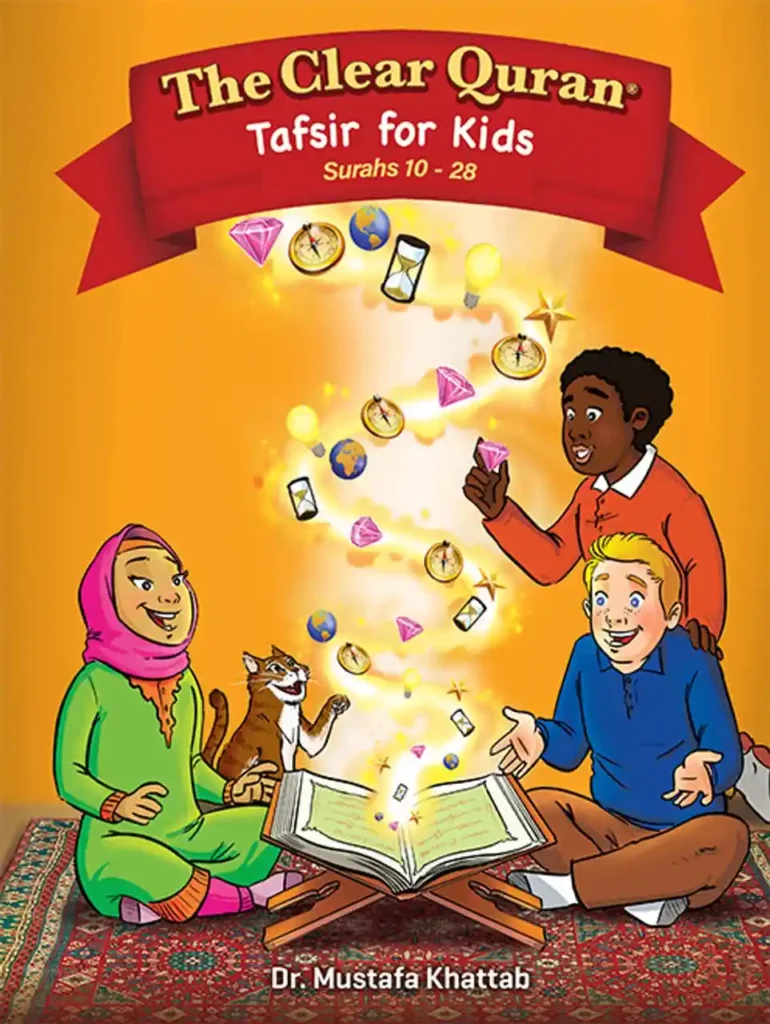
Volume 2 covers Surahs 10–28. Product information lists Arabic and English, a hardcover format, and educational elements such as learning points, contextual background, stories, and explanations.
Age/Reading Level
Generally suitable for children around 7+ who can work with longer explanations.
Language
English and Arabic.
Pros
- Continues the same structured series
- Child-friendly explanations
- Useful for home or classroom learning
- Hardcover construction
Cons
- Not a compact Quran for carrying everywhere
- Not primarily a Tajweed teaching edition
- Better suited to guided study than first-stage Arabic reading
Why Parents May Consider It
For families already using Volume 1, Volume 2 provides continuity. It can also be useful for parents and teachers who want to discuss Quranic passages with children rather than simply ask them to recite.
3. The Clear Quran for Kids – Volume 3
Best For
Best for children studying Quranic meaning and context.
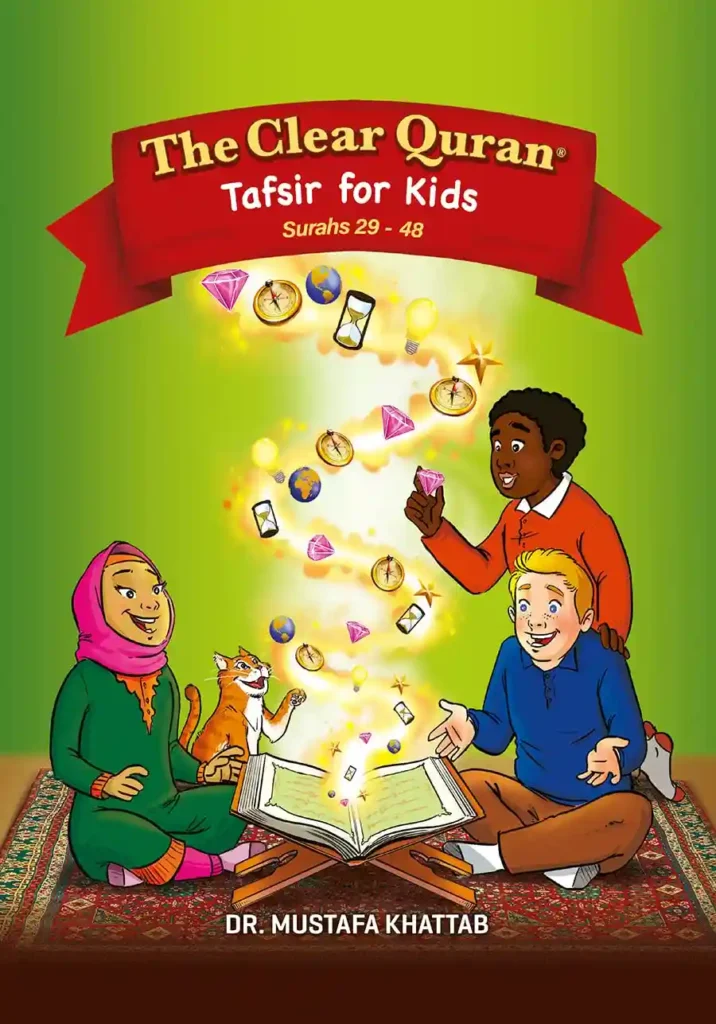
Volume 3 covers Surahs 29–48. The publisher lists it as a hardcover edition with English and Arabic text, and explains that difficult vocabulary is simplified or explained through a glossary.
Age/Reading Level
Generally aimed at children around 7+.
Language
English with Arabic text.
Pros
- Child-friendly vocabulary
- Illustrations and explanations
- Useful for family discussion
- Hardcover format
Cons
- Large physical size
- Not a traditional pocket Mushaf
- Translation/tafsir focus means it is not the best choice for someone specifically seeking Tajweed color coding
Why Parents May Consider It
Parents looking for a Quran with translation for kids may find this type of resource more useful than a standard Arabic-only Mushaf when the child’s goal includes understanding.
4. The Clear Quran for Kids – Volume 4
Best For
Best for children focusing on shorter Surahs and commonly learned passages.
Volume 4 contains Surah 1 and Surahs 49–114 according to the publisher’s current series listing.
This makes it particularly relevant for children working through shorter Surahs commonly encountered during early Quran learning and memorization.
Age/Reading Level
Generally aimed at children around 7+.
Language
English with Arabic text.
Pros
- Focuses heavily on shorter Surahs
- Child-friendly explanations
- Useful for family study
- Part of a complete four-volume series
Cons
- Large format
- Not a substitute for a teacher
- Not primarily a transliteration or Tajweed Mushaf
Why Parents May Consider It
If your child is learning shorter Surahs while beginning to explore their meanings, this volume may provide a useful bridge between memorization and understanding.
5. My First Quran with Pictures – Juz Amma Part 1
Best For
Best for younger children who benefit from visual learning.
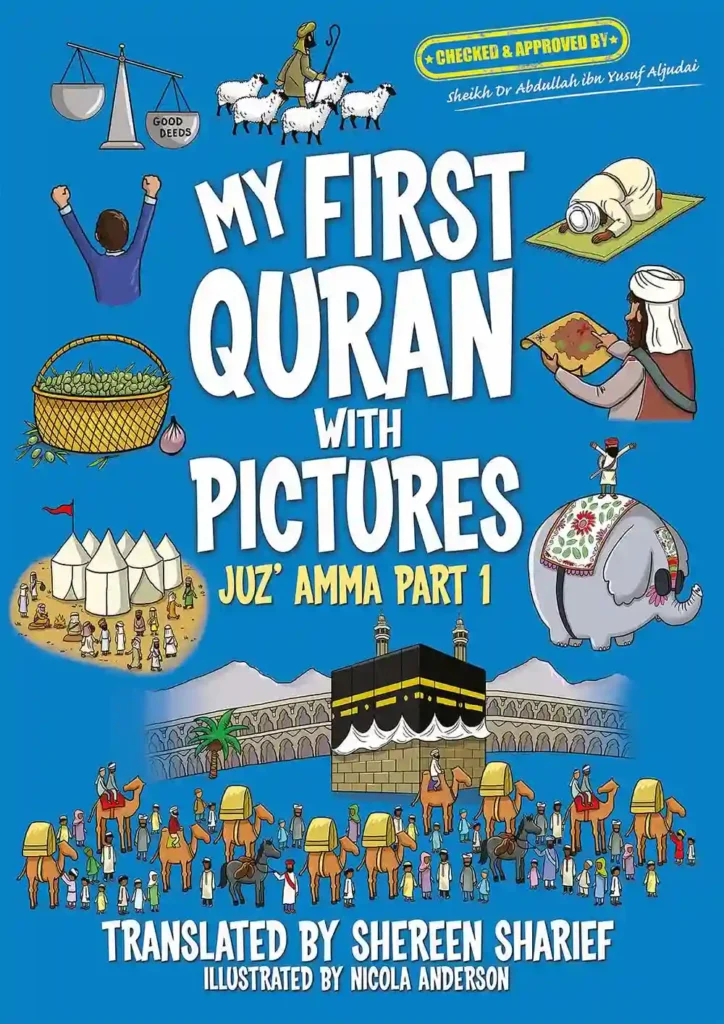
My First Quran with Pictures – Juz Amma Part 1 by Shereen Sharief uses illustrations to help children connect short Quranic passages with basic meanings. Madinah Media lists it as English and Arabic, paperback, and intended for elementary-school children. It covers Surah Al-Balad through Surah An-Nas.
Another bookseller lists the edition as a 48-page softcover with color illustrations and Quranic Studies for ages 7+.
Age/Reading Level
Listings vary, so parents should use the child’s actual reading ability rather than age alone.
Language
English and Arabic.
Pros
- Visual learning
- Arabic alongside simple meaning
- Focuses on Juz Amma
- Useful for memorization and discussion
Cons
- Not a complete Quran
- Not a Tajweed Mushaf
- Illustrations may not suit every family’s preferred learning style
Why Parents May Consider It
For a young learner, connecting a short Surah with a simple visual explanation can make a lesson more interactive. It can work particularly well as a companion resource alongside regular Quran recitation.
6. My First Quran with Pictures – Juz Amma Part 2
Best For
Best for children continuing visual Juz Amma study.
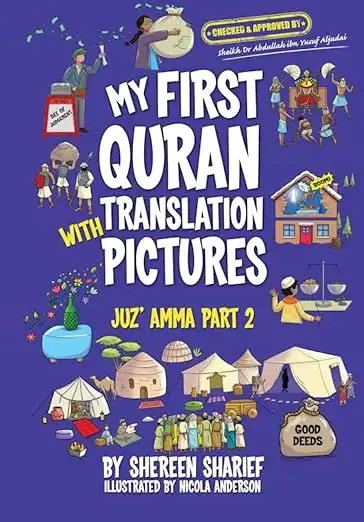
Part 2 continues the My First Quran with Pictures approach. Madinah Media describes it as a paperback resource in English and Arabic and lists Surahs from Al-Fajr to An-Naba, with 76 pages.
Age/Reading Level
Some listings place it around 9–10+, but children’s reading levels differ.
Language
English and Arabic.
Pros
- Continues the visual approach
- Arabic and simple meaning
- Useful for memorization support
- Large visual learning component
Cons
- Covers only selected Surahs
- Not a complete Mushaf
- Not designed as a traditional Tajweed Quran
Why Parents May Consider It
This is better viewed as a Quran learning book for children than as a replacement for a standard Quran. It may be especially useful when parents want to discuss meanings alongside memorization.
7. My First Quran Storybook
Best For
Best for introducing young children to Quranic stories.
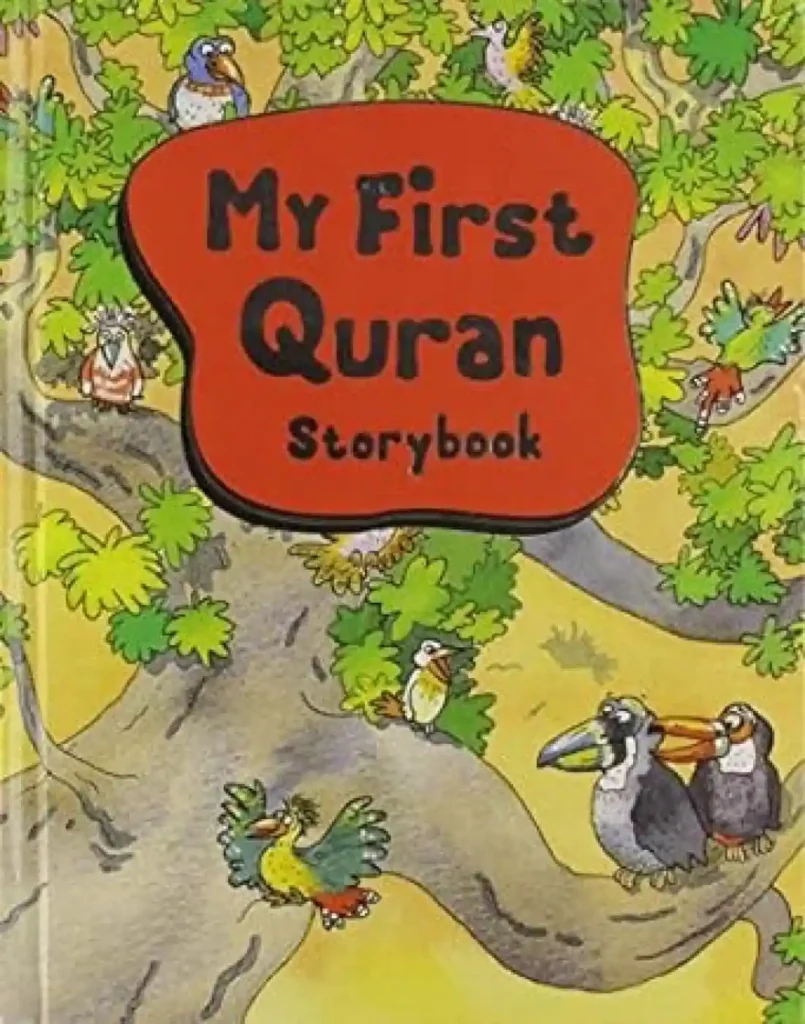
My First Quran Storybook by Saniyasnain Khan is a children’s hardcover book published by Goodword Books. Jarir Books lists it for ages 6–12 and describes 42 Quran-based stories, each with a moral value and Quran reference.
Age/Reading Level
Approximately 6–12 according to the bookseller listing.
Language
English.
Pros
- Accessible for young readers
- Illustrated
- Quran references included
- Suitable for family reading
- Can introduce Quranic narratives before independent Quran study
Cons
- Not a Quran Mushaf
- Does not replace Arabic Quran reading
- Story format may be more suitable as a companion resource
Why Parents May Consider It
Children do not always need another full Quran immediately. A story-based resource can help introduce themes and narratives in an age-appropriate way while parents continue formal Quran reading separately.
8. Juz ‘Amma Primer – With Color Codes for Tajweed
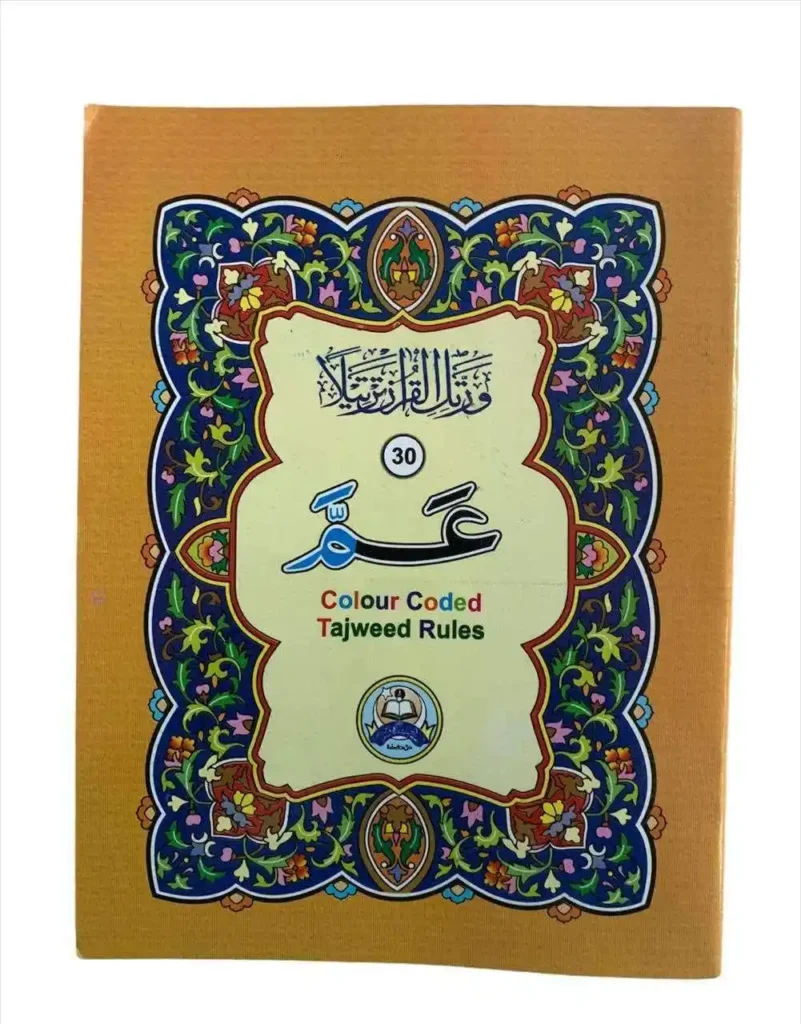
Best For
Best for children beginning Tajweed practice.
The Juz ‘Amma Primer – With Color Codes for Tajweed uses different colors to identify Tajweed rules and includes English explanations of the rules. The listed edition is specifically described as a large edition intended to facilitate Quran reading for young children and is printed on heavy art paper.
Age/Reading Level
Best suited to children who have already started Arabic Quran reading.
Language
Arabic with English Tajweed explanations.
Pros
- Color-coded Tajweed
- Focuses on Juz Amma
- English rule explanations
- Large format
- Heavy paper
Cons
- Not a complete Quran
- Not suitable as a first Arabic-letter book
- Children still need pronunciation instruction
Why Parents May Consider It
Color coding can provide a visual reminder of Tajweed rules while children read. However, color systems can differ between publishers, so parents should use the rule legend supplied with the specific edition.
Best Quran for Younger Children
For younger learners, parents should prioritize readability over complexity.
A large, clear Arabic font can be more useful than a sophisticated Quran containing many features the child cannot yet understand. Visual learning resources such as My First Quran with Pictures may also be useful for connecting short Surahs with basic meanings.
Durability matters too. A child who uses a book frequently at home or during Quran class may benefit from sturdy construction.
For a very young child, parent-assisted reading is often more realistic than expecting independent Quran study.
Best Quran for Kids Learning Arabic
Children learning Arabic Quran reading need to develop several skills progressively:
- Recognizing Arabic letters
- Understanding vowel marks
- Joining letters
- Reading words
- Reading Quranic phrases
- Improving pronunciation
- Learning Tajweed rules
A full Mushaf may not be the best starting point for a child who cannot yet recognize Arabic letters. A Noorani Qaida or Iqra-style beginner book can be a more appropriate companion resource before moving to a complete Quran.
For example, a color-coded Iqra Qaida is specifically designed around beginner Quran reading and Tajweed foundations.
Best Quran With Transliteration for Kids
Transliteration represents Arabic pronunciation using another writing system, such as the Latin alphabet.
For example, a child who cannot yet read Arabic may use transliteration as a temporary pronunciation aid.
However, transliteration should generally be treated as a learning support, not a permanent replacement for Arabic Quran reading. Parents can gradually help children move from transliteration toward reading the Arabic text directly.
When shopping for a best Quran for kids with transliteration, check the actual edition carefully. Do not assume that a children’s Quran contains transliteration simply because it is marketed toward beginners.
Best Quran With English Translation for Kids
English-speaking Muslim families in the USA, UK, Canada, Australia, and elsewhere may want children to understand what they are reading.
A Quran with English translation can help children connect Arabic recitation with meaning. However, parents should explain an important distinction:
The Quran is the Arabic revelation. An English translation is a human rendering of its meaning.
For children, an accessible translation may be easier to understand than highly formal or archaic English.
The Clear Quran for Kids series is specifically designed around this need, combining Arabic text with child-oriented English explanations and learning material.
Parents should avoid asking children to memorize English translation as though it were the Arabic Quran.
Best Tajweed Quran for Kids
What Is Tajweed?
Tajweed refers to rules used for proper Quranic pronunciation and recitation.
Color-coded Mushafs can visually mark certain Tajweed rules. The exact color system is not universal, so parents should always read the legend included in the specific Quran they purchase.
A color-coded Juz Amma edition can be particularly practical for children who are beginning to apply Tajweed while reading shorter Surahs.
Color coding, however, is not a substitute for listening to a qualified teacher. A child may understand what a color represents without producing the correct sound.
How to Choose a Quran for Your Child
1. Consider Your Child’s Age
Age provides a starting point, not a fixed rule. A confident 7-year-old reader may use a resource that is difficult for another child of the same age.
2. Check Arabic Reading Ability
Ask whether your child can recognize letters, read connected words, and read Quranic text independently.
3. Decide Whether Translation Is Needed
If your family primarily speaks English, an accessible English translation can support understanding.
4. Consider Transliteration Carefully
Transliteration can help beginners pronounce words, but encourage gradual movement toward Arabic reading.
5. Look at Tajweed Needs
A beginner may need simple Tajweed guidance. An advanced student may prefer a full color-coded Tajweed Mushaf.
6. Check Font Size
Never underestimate the importance of readable text.
7. Examine Page Layout
A crowded page can overwhelm a beginner. Look for clear spacing and a logical layout.
8. Consider Binding
Hardcover editions are generally more appropriate for frequent family or classroom use, while paperback books may be lighter and easier to carry.
9. Think About Portability
A large children’s learning book can be excellent at home but inconvenient for travel.
10. Set a Realistic Budget
The most expensive Quran is not automatically the best Quran for your child.
11. Consider Educational Goals
Are you trying to teach:
- Arabic reading?
- Memorization?
- Meaning?
- Tajweed?
- Islamic stories?
- Independent Quran study?
The answer should guide your purchase.
Best Quran by Age
Ages 4–6
Focus on:
- Large Arabic letters
- Short sessions
- Parent assistance
- Simple Quran learning books
- Visual resources
- Arabic alphabet and Qaida preparation
Do not expect every child to progress at the same pace.
Ages 7–9
Consider:
- Juz Amma resources
- Arabic + English books
- Simple explanations
- Beginner Tajweed
- Short daily reading sessions
The My First Quran with Pictures resources may be worth considering for children who respond well to visual learning.
Ages 10–12
Children may be ready for:
- More independent Arabic reading
- English translation
- Structured Quran study
- Tajweed practice
- Longer Quran sessions
The Clear Quran for Kids series may be particularly useful for this type of guided understanding.
Ages 13+
Teenagers can often transition toward:
- Standard Mushafs
- Color-coded Tajweed Qurans
- Arabic-English Qurans
- Tafsir resources
- Independent Quran study
At this stage, reading ability and learning objectives are usually more important than the “kids” label on the cover.
Quran With Transliteration vs Translation
| Feature | Transliteration | Translation |
|---|---|---|
| Main purpose | Helps represent pronunciation | Explains meaning |
| Uses Arabic text? | Usually alongside Arabic | Usually alongside Arabic |
| Helps pronunciation? | Yes | No |
| Helps understand meaning? | Very limited | Yes |
| Best for | Beginners needing pronunciation support | Readers learning meaning |
| Should replace Arabic reading? | No | No |
A Quran with transliteration for kids can be useful when a child is still developing Arabic reading skills. A translation is useful when the child’s goal is understanding.
They solve different problems.
Is a Children’s Quran Different From a Regular Quran?
A children’s Quran resource can look very different from a standard Mushaf, but parents should examine exactly what the book contains.
Some products contain the Arabic Quran with educational formatting. Others contain selected Surahs, translation, tafsir, stories, or learning exercises.
For example, The Clear Quran for Kids is described by its publisher as an illustrated children’s exegesis rather than simply a standard Mushaf.
Similarly, My First Quran with Pictures focuses on selected Juz Amma material and visual explanations.
Educational presentation does not mean that every children’s book is itself a complete Quran. Parents should always check the publisher, edition, contents, and ISBN before buying.
How to Help Your Child Start Reading the Quran
A good book is only one part of Quran learning.
Start With Short Sessions
Ten focused minutes can be more productive than a long session that leaves a child frustrated.
Create a Consistent Routine
Choose a time when your child is usually alert and relaxed.
Encourage Rather Than Pressure
Celebrate genuine improvement instead of comparing one child with another.
Practice Pronunciation
Read slowly and let your child listen and repeat.
Read Together
Parents can model good reading habits by sitting with children.
Celebrate Progress
Recognize milestones such as completing a Surah, improving a letter sound, or becoming more independent.
Use Age-Appropriate Islamic Stories
Quran stories and Islamic children’s books can help children connect lessons with everyday life. My First Quran Storybook, for example, presents Quran-related stories with moral lessons and Quran references for young readers.
Consider a Qualified Quran Teacher
A teacher can identify pronunciation problems that parents may not notice and can provide structured Tajweed instruction.
For parents building a broader Islamic learning routine, our guide on Raising Children in Islam also discusses introducing Quran, Salah, Duas, and Islamic manners gradually.
Common Mistakes Parents Should Avoid
1. Choosing Only Based on Price
The cheapest book may not have the readability or durability your child needs.
2. Buying an Edition That Is Too Advanced
A sophisticated Tajweed Quran may frustrate a child who is still learning Arabic letters.
3. Relying Only on Transliteration
Transliteration can be useful, but children should gradually develop Arabic reading skills.
4. Ignoring Font Size
Small text can make Quran reading unnecessarily difficult.
5. Choosing an Unsuitable Translation
English translations vary in style and reading level. Select one your child can understand.
6. Making Quran Learning Feel Like Punishment
Children generally respond better to encouragement, routine, and positive reinforcement.
7. Comparing Children
Two children of the same age can have very different reading abilities.
Helpful Quran and Islamic Resources for Families
After choosing a Quran, families can build a broader learning routine with practical resources from OnlyIslamWay.
For children learning short Surahs, consider our Surah Ikhlas PDF and Ayatul Kursi PDF.
Families can also explore Surah Yaseen PDF resources and our other Quran PDF guides as part of a structured reading and memorization routine.
For daily Islamic practice, parents may also find our Namaz Ka Tarika Step by Step helpful.
You can also explore How to Perform Wudu Step by Step and Daily Islamic Duas to build a broader home learning routine.
Frequently Asked Questions
1. What is the best Quran for kids?
There is no single best Quran for every child. Younger children may benefit from large text and visual resources, while older children may prefer an Arabic-English Quran, child-friendly tafsir, or color-coded Tajweed edition.
2. What age should a child start reading the Quran?
Children can be introduced to Quran learning from a young age, but there is no universal age at which every child should read independently. Start according to the child’s readiness and ability.
3. Is transliteration good for children learning Quran?
It can be helpful as a temporary pronunciation aid for children who cannot yet read Arabic confidently. However, children should gradually learn to read the original Arabic text.
4. Should kids use a Quran with English translation?
It can be very useful for English-speaking families who want children to understand the meaning. Parents should explain that an English translation conveys meaning and is not the Arabic Quran itself.
5. What is the best Quran for beginners?
For a child who cannot yet read Arabic, a beginner Qaida may be more appropriate than a complete Mushaf. Once basic Arabic reading develops, a clear Quran with appropriate font size can be introduced.
6. Is a Tajweed Quran suitable for children?
Yes, especially for children who can already read Arabic. Color-coded Tajweed editions can provide useful visual cues, although teacher guidance remains valuable.
7. How can I make Quran reading interesting for my child?
Keep sessions short, read together, use age-appropriate stories and visual learning resources, celebrate progress, and connect lessons with everyday life.
8. What should I look for when buying a Quran for kids?
Consider Arabic readability, font size, layout, age suitability, translation, transliteration, Tajweed features, durability, portability, and your child’s specific learning goal.
Featured Snippet: What Is the Best Quran for Kids?
The best Quran for kids depends on the child’s age, Arabic reading ability, and learning goals. Younger beginners may benefit from large, clear text and visual resources, while older children may prefer an Arabic-English Quran, child-friendly tafsir, or color-coded Tajweed edition. Choose the format your child can actually use consistently.
Conclusion
There is no single Best Quran for Kids that will be perfect for every Muslim child. A four-year-old beginning Arabic letters has different needs from a 10-year-old learning Tajweed or a teenager studying Quranic meaning.
Start by considering your child’s age and reading ability. Look for clear Arabic text, an appropriate font size, a simple page layout, and durable construction. If your child speaks English primarily, an accessible translation may help with understanding. Transliteration can support beginners, while color-coded Tajweed can help learners recognize recitation rules.
Most importantly, remember that the book is a tool—not the entire learning experience. Children benefit from patient guidance, regular practice, encouragement, and, when possible, instruction from a qualified Quran teacher.
Choose a resource that makes Quran learning manageable rather than overwhelming. With consistency and encouragement, children can gradually develop stronger reading, recitation, understanding, and appreciation.
Explore more Quran, Dua, Namaz, and Islamic learning resources on OnlyIslamWay.
❤️ Enjoying Our Free Islamic Resources?
If this article has benefited you, please consider supporting OnlyIslamWay. Your contribution helps us continue providing free Islamic educational resources for Muslims worldwide.
❤️ Donate with PayPal