
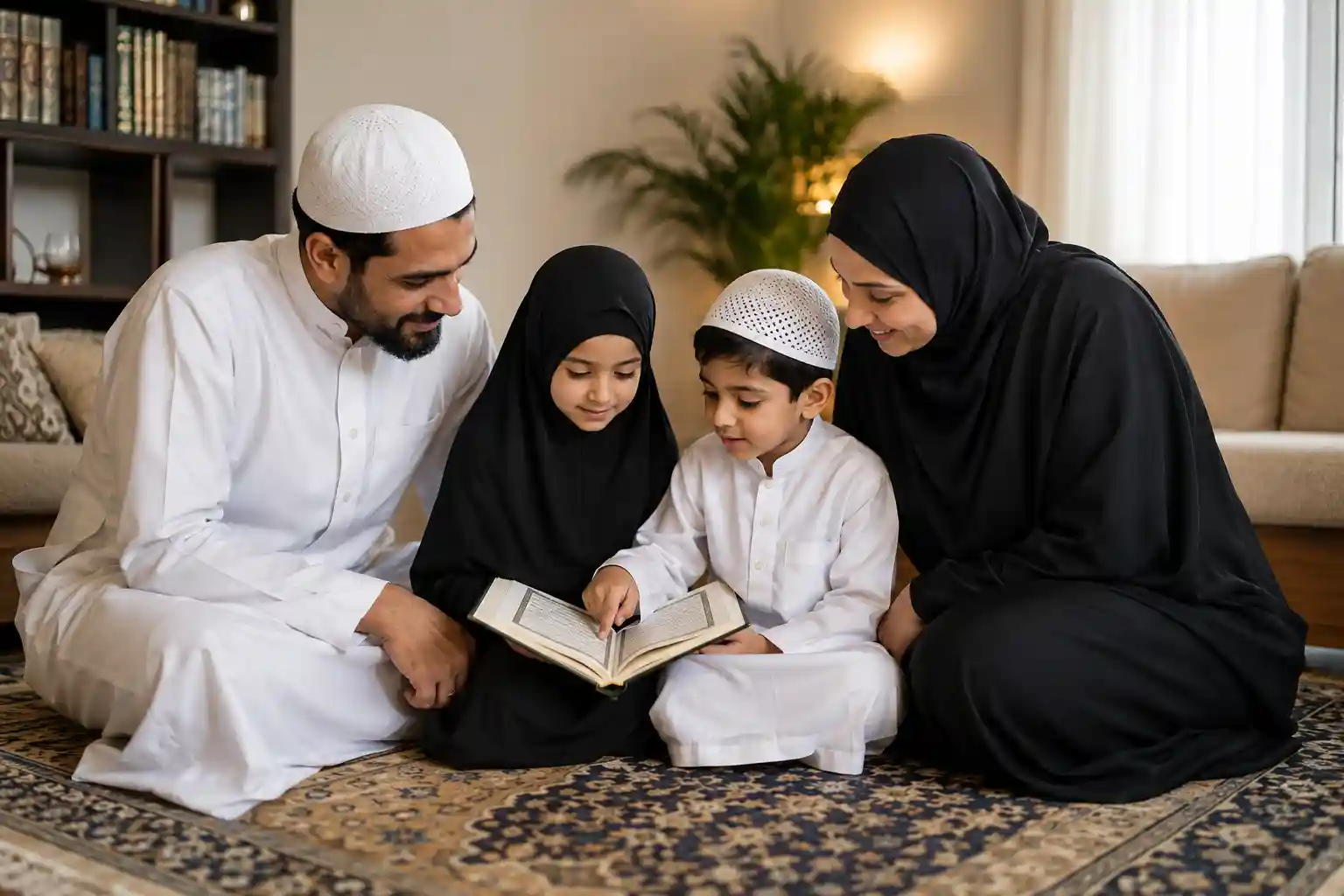
Raising children is one of the greatest responsibilities a parent can have. For Muslim parents, that responsibility includes more than providing food, education, clothing, and a safe home. Raising children in Islam also means nurturing faith, good character, compassion, responsibility, manners, and a meaningful relationship with Allah.
Islamic parenting is not about expecting children to become perfect overnight. It is a gradual process of teaching, modeling, encouraging, correcting, listening, and making Dua. Children learn not only from what parents tell them but also from what they see every day.
The Quran reminds believers to protect themselves and their families, while the Quranic account of Luqman’s advice to his son provides a beautiful example of teaching faith, prayer, humility, patience, and good conduct.
For Muslim families in the USA, UK, Canada, and elsewhere, raising children can also involve balancing Islamic values with school, friendships, social media, popular culture, and different cultural environments. The goal is not to isolate children from the world but to give them the knowledge, confidence, character, and faith to navigate it responsibly.
What Does Raising Children in Islam Mean?
Raising children in Islam means helping a child grow spiritually, emotionally, morally, socially, and intellectually while introducing Islamic beliefs and practices in an age-appropriate way.
The Quran says:
“And enjoin prayer upon your family [and people] and be steadfast therein.” — Qur’an 20:132
The responsibility is therefore not limited to teaching children to recite Quran or perform Salah. Parents can also teach children why Muslims worship Allah, why honesty matters, why kindness is important, how to treat other people, how to control anger, and how to take responsibility for their actions.
The Prophet Muhammad ﷺ also described people as responsible guardians over those in their care. Sahih al-Bukhari 893 records this principle specifically in relation to family responsibility.
This means Islamic parenting combines faith, education, character, affection, boundaries, and example.
💧 Learn Wudu Step by Step
Want to learn the correct way to perform Wudu before Salah? Follow our complete beginner-friendly guide with easy steps, pictures, duas, and important Sunnah tips.
Read Complete Wudu Guide1. Teach Children About Allah
One of the foundations of Islamic parenting is helping children know Allah.
Young children naturally ask questions:
- Who created us?
- Where is Allah?
- Why do we pray?
- Why should I be good?
- Does Allah hear my Dua?
- Why can’t I see Allah?
These questions should be welcomed rather than discouraged.
Teach Allah’s mercy and care
Parents can explain Allah to children using simple concepts appropriate to their age. Talk about Allah as the Creator and explain that Muslims worship Him, thank Him, ask Him for help, and rely upon Him.
Instead of making religion primarily about punishment, build a balanced understanding of Allah’s mercy, justice, wisdom, and guidance.
For example, when a child shares something with a sibling, a parent might say:
“That was kind. Allah loves good and kind behavior.”
When something goes well:
“Alhamdulillah. We should thank Allah for this blessing.”
When a child is worried:
“You can make Dua and ask Allah for help.”
This turns everyday experiences into opportunities for teaching children about Allah.
The advice of Luqman to his son in Qur’an 31:13–19 is particularly valuable because it combines belief in Allah with prayer, patience, humility, and respectful behavior.
2. Teach the Quran From an Early Age
Teaching children Quran should be a gradual and positive experience.
Parents can introduce the Quran through:
- Short Surahs
- Listening to recitation
- Reading together
- Memorizing small portions
- Learning simple meanings
- Talking about lessons from the Quran
- Connecting verses to everyday life
A child does not need to spend hours studying every day to develop a relationship with the Quran.
Consistency is often more practical than occasional long sessions.
For example, a family might establish a simple routine of reading or listening to Quran for 10–15 minutes after Maghrib. Another family may choose a short Quran session before bedtime.
The important point is to make Quran learning meaningful rather than turning every session into a source of stress.
Parents can also use age-appropriate explanations. A young child may simply learn the meaning of a short Surah, while an older child can discuss its message and how it applies to real situations.
If your child enjoys stories, use Quranic stories to discuss values such as patience, trust in Allah, courage, forgiveness, and perseverance.
3. Teach Children Salah
Children and Salah should become familiar with prayer through gradual practice and a positive family routine.
One of the best ways to begin is by allowing children to watch their parents pray.
A young child may imitate movements without understanding everything. That is normal. Over time, parents can introduce:
- Wudu
- Basic prayer positions
- Short Surahs
- Simple phrases of Salah
- The correct sequence
- The meaning of what is being recited
- A regular prayer routine
The Quran instructs believers to enjoin prayer upon their families and remain steadfast in doing so.
There is also a well-known narration concerning children’s prayer. Sunan Abi Dawud 495 reports that the Prophet ﷺ instructed parents to command children to pray at seven and mentioned discipline regarding prayer at ten; the narration is graded Hasan Sahih by Al-Albani on the cited source.
Because the wording of this narration involves discipline, parents should not reduce it to a slogan or use it to justify anger or abuse. Islamic parenting should take the wider Prophetic example of mercy, wisdom, gradual teaching, and responsibility seriously.
For younger children, make prayer inviting. Give them a small prayer mat, let them stand beside you, and praise genuine effort.
The goal is to help Salah become something familiar and meaningful rather than something associated only with arguments.
Ready to Learn How to Pray Salah?
Now that you’re learning how to read Arabic, the next important step is learning how to perform Salah correctly. Follow our complete beginner-friendly guide that explains every prayer step with easy instructions and illustrations.
📖 How to Pray Salah Step by Step (Complete Beginner’s Guide)4. Teach Good Islamic Manners
Islamic manners for children should be taught through everyday situations.
Important qualities include:
- Honesty
- Respect
- Kindness
- Patience
- Gratitude
- Keeping promises
- Speaking politely
- Helping others
- Respecting parents
- Caring about neighbors
- Controlling anger
- Saying sorry after making a mistake
Parents can teach these values through practical examples.
If a child lies, explain why honesty matters rather than simply labeling the child as “bad.”
If siblings argue, teach them how to apologize, listen, and resolve disagreements.
If a child receives something from someone, teach gratitude.
If someone needs help, involve the child in helping.
This is Islamic character building in everyday life.
Luqman’s advice to his son includes prayer, patience, avoiding arrogance, and speaking appropriately, showing that Islamic education encompasses both worship and behavior.
5. Discipline Children According to Islamic Principles
Discipline is part of parenting, but discipline should not mean constant shouting, humiliation, or fear.
Effective discipline in Islam can include:
- Clear expectations
- Consistent boundaries
- Calm correction
- Natural or reasonable consequences
- Explaining why behavior is wrong
- Giving children opportunities to correct mistakes
- Avoiding public humiliation
- Showing affection even while correcting behavior
Parents should distinguish between correcting an action and attacking a child’s identity.
Instead of saying:
“You are a bad child.”
Try:
“What you did was wrong, but you can fix it.”
This helps children understand that mistakes can be corrected.
Mercy is also important. In Sahih al-Bukhari 5997, the Prophet ﷺ kissed his grandson al-Hasan, and when someone mentioned that he did not kiss his own children, the Prophet ﷺ emphasized mercy.
A healthy Islamic home can therefore have rules and boundaries without becoming emotionally harsh.
6. Be a Good Example
Children often learn more from what parents do than from what parents say.
If you want your child to pray, let them see you pray.
If you want them to read Quran, let them see you reading Quran.
If you want honesty, practice honesty.
If you want patience, demonstrate patience.
If you want forgiveness, let your children see you apologize when you make a mistake.
This is one of the most powerful Islamic parenting tips because children observe everyday behavior.
A parent who tells a child, “Don’t lie,” but lies in front of the child sends conflicting messages.
Similarly, telling children to control anger while frequently shouting can make the lesson difficult to accept.
Parents are not expected to be perfect. Instead, they can model what it means to recognize mistakes, seek forgiveness, and try again.
7. Create an Islamic Home Environment
An Islamic home does not have to feel like a classroom.
Faith can become part of normal family life.
Consider:
- Praying together when practical
- Reading Quran together
- Making Dua as a family
- Discussing Islamic stories
- Keeping age-appropriate Islamic books available
- Encouraging good behavior
- Talking about gratitude
- Sharing meals together
- Discussing questions about faith
- Marking Islamic occasions in ways consistent with your family’s understanding of Islam
Small routines can make a significant difference.
For example, before sleeping, parents can encourage children to remember Allah and make their daily Dua. During meals, children can learn Islamic manners. During a family outing, parents can point out Allah’s creation and encourage gratitude.
The aim is to make Islam part of family life rather than something that exists only during Quran class.
8. Teach Children Islamic Stories
Stories can be one of the most effective ways of teaching Islam to children.
The Quran contains accounts that provide opportunities to discuss:
- Patience
- Trust in Allah
- Courage
- Truthfulness
- Perseverance
- Forgiveness
- Gratitude
- Obedience to Allah
For example, the Quran presents Luqman’s advice to his son as a series of lessons about belief, worship, patience, humility, and manners.
When telling stories of the Prophets and other figures mentioned in reliable Islamic sources, parents should use trustworthy sources and avoid adding invented details simply to make a story more dramatic.
After a story, ask:
“What can we learn from this?”
This turns passive listening into Islamic character education.
9. Teach Children Dua and Dhikr
Daily Duas can help children connect ordinary activities with remembrance of Allah.
Depending on age, parents can gradually teach Duas associated with:
- Eating
- Sleeping
- Waking
- Leaving home
- Entering the bathroom
- Traveling
- Seeking knowledge
- Entering and leaving the masjid
Do not focus only on memorization.
Explain the meaning whenever possible.
For example, when teaching a Dua asking Allah for beneficial knowledge, explain why seeking useful knowledge is valuable.
Parents can also make Dua with their children:
“Let’s ask Allah to help us be honest.”
“Let’s ask Allah to make us grateful.”
This teaches children that Dua is not merely a memorized formula; it is a way of turning to Allah.
10. Balance Islamic Education With School and Modern Life
Muslim parents in the USA, UK, Canada, and other non-Muslim-majority environments may face unique challenges.
Children may encounter different beliefs, lifestyles, holidays, social expectations, and online content.
The answer is not necessarily to avoid every difference.
Instead, parents can give children a strong foundation so they understand why their family follows certain Islamic values.
Discuss topics such as:
- Islamic identity
- Friendship
- Peer pressure
- Social media
- Online safety
- Modesty
- Respect for different people
- School activities
- Cultural differences
- Responsible technology use
Encourage children to ask questions.
If a child asks something difficult about Islam, avoid responding with anger simply because the question makes you uncomfortable. If you do not know the answer, say so and research it together with a qualified and trustworthy source.
This can strengthen rather than weaken a child’s faith.
11. Teach Children About Respect and Kindness Toward Others
Muslim children should learn to treat people with fairness, honesty, and good manners.
At school, this may mean:
- Including classmates
- Avoiding bullying
- Respecting teachers
- Helping someone who is struggling
- Not making fun of another person’s background
- Keeping promises
- Speaking respectfully
Children can maintain their Islamic identity while treating people from different backgrounds with dignity.
Parents should also distinguish between Islamic teachings and cultural customs. A particular food, style of clothing, family tradition, or cultural practice should not automatically be described as an Islamic obligation.
Teaching children this distinction can help them understand Islam more clearly.
12. Raising Children With Love, Mercy, and Patience
A strong emotional relationship makes parenting easier.
Children need to know that they are loved even when they make mistakes.
Spend time together without turning every conversation into a lesson.
Ask your child:
“How was your day?”
“What was the best part?”
“Did anything make you worried?”
Listen without immediately judging.
Praise genuine effort and good behavior.
Give affection.
Celebrate progress.
And allow children to ask questions about Allah, Islam, friendships, school, and life.
The Prophetic example includes affection toward children, and the narration in Sahih al-Bukhari 5997 highlights the importance of mercy.
Common Mistakes Muslim Parents Should Avoid
Even parents with good intentions can make mistakes.
1. Using religion only to create fear
If every religious conversation is about punishment, children may develop an unhealthy association between Islam and fear.
Teach responsibility while also teaching Allah’s mercy, forgiveness, wisdom, and blessings.
2. Comparing siblings
Avoid statements such as:
“Why can’t you be like your brother?”
Children have different personalities and strengths.
3. Expecting perfection
A child learning Salah, Quran, manners, or self-control will make mistakes.
Teach progress rather than demanding instant perfection.
4. Forcing without explanation
Rules sometimes need to be enforced, but children also benefit from understanding why Islamic practices matter.
5. Ignoring emotional needs
A child can memorize Quran and still need someone to listen to their worries.
6. Teaching rituals without meaning
Help children understand what they are saying and doing.
7. Being inconsistent
If a rule changes every day, children struggle to understand boundaries.
8. Expecting children to follow rules parents ignore
Parents should make an honest effort to practice the values they teach.
Age-Appropriate Islamic Parenting
Young Children
Focus on:
- Love and affection
- Simple Duas
- Short Islamic stories
- Basic manners
- Gratitude
- Observing parents pray
- Simple Quran exposure
Keep lessons short and enjoyable.
School-Age Children
Gradually introduce:
- Regular Salah
- Wudu
- Quran reading
- Islamic knowledge
- Responsibility
- Helping at home
- Good friendship habits
- More detailed Islamic manners
Give children small responsibilities that increase with age.
Teenagers
Teenagers often need a different parenting approach.
Focus on:
- Communication
- Islamic identity
- Critical thinking
- Peer pressure
- Modesty
- Online behavior
- Friendships
- School and career
- Trust and responsibility
- Asking difficult questions
Instead of turning every discussion into a lecture, sometimes begin by listening.
A teenager who feels safe asking questions is more likely to seek guidance from parents rather than unreliable online sources.
🕌 Looking for a comfortable prayer mat? Discover our top recommendations for daily Salah.
🛍️ Best Prayer Mat for Daily Salah →10 Practical Islamic Parenting Tips
- Pray regularly yourself so children see Salah as part of normal life.
- Create a short daily Quran routine instead of relying only on long weekend lessons.
- Teach one Islamic manner at a time and practice it at home.
- Use everyday situations to teach about Allah.
- Make Dua with your children and explain what you are asking Allah for.
- Praise good character, not only academic or religious achievement.
- Set clear and consistent boundaries while remaining calm.
- Listen to children’s questions without immediately becoming angry.
- Spend regular one-on-one time with each child.
- Ask Allah for help in raising righteous children.
Remember that raising righteous children is a journey. Parents can provide guidance and effort, but they cannot control every decision a child will eventually make.
Frequently Asked Questions About Raising Children in Islam
1. What does Islam say about raising children?
Islam places responsibility on parents to care for and guide their families. The Quran instructs believers to protect their families and specifically instructs families regarding prayer.
2. How can I teach my child about Allah?
Start with simple, age-appropriate conversations about Allah as the Creator, His blessings, mercy, and why Muslims worship Him. Use everyday experiences, Quranic stories, gratitude, and Dua rather than relying only on formal lessons.
3. How do I teach my child Salah?
Let children watch you pray, teach Wudu and the basic movements gradually, practice together, and establish a positive routine. The Quran instructs believers to enjoin prayer upon their families and remain steadfast in it.
4. At what age should children learn Quran?
There is no single age at which every child must begin Quran learning. Young children can be introduced gradually through listening, short Surahs, simple reading, and stories. As they mature, their learning can become more structured.
5. How can I encourage my child to pray?
Make prayer part of family life. Pray together, let children observe you, explain why Salah matters, praise effort, and maintain a consistent routine. Avoid turning every prayer into an angry confrontation.
6. How should Muslim parents discipline children?
Use clear boundaries, consistency, patience, correction, and reasonable consequences. Discipline should teach rather than humiliate. Parents should also remember the importance of mercy and affection shown in the Prophetic example.
7. How can I raise Muslim children in a non-Muslim country?
Give children a strong understanding of Islamic beliefs and values while teaching them respectful interaction with people from different backgrounds. Discuss school, friendships, social media, identity, and peer pressure openly.
8. How can parents become good Islamic role models?
Practice the values you want your children to learn. Let them see you pray, read Quran, speak honestly, apologize when wrong, show gratitude, help others, and remain patient during difficult situations.
Helpful Islamic Resources for Parents
Parents building an Islamic learning routine may benefit from practical resources such as:
- A Salah guide for learning the prayer step by step
- A Wudu guide for teaching children purification
- Daily Duas for common activities
- Dua before sleeping for a simple bedtime routine
- Namaz guides for children and beginners
- Age-appropriate Surah PDFs for Quran reading and memorization
When adding these resources to your website, use descriptive internal-link anchor text such as “learn how to perform Salah step by step,” “complete Wudu guide,” “daily Duas for Muslims,” or “Dua before sleeping” rather than generic anchors such as “click here.”
Conclusion
Raising children in Islam is not about producing perfect children. It is about creating an environment where faith, good character, love, responsibility, and remembrance of Allah can grow over time.
Teach children about Allah with wisdom. Introduce the Quran gradually. Help them develop a relationship with Salah. Teach honesty, kindness, patience, humility, and respect. Establish boundaries without making the home emotionally harsh. Most importantly, let children see Islamic values practiced by the adults they trust.
The Quran’s instruction to enjoin prayer upon one’s family also says to remain steadfast in doing so. That reminder is important for parents: Islamic parenting itself requires patience and consistency.
There will be difficult days. Children will make mistakes. Parents will make mistakes too. What matters is continuing to teach, listen, correct, encourage, make Dua, and turn back to Allah.
May Allah guide Muslim parents, bless their families, and help them raise children who grow in faith, character, knowledge, kindness, and righteousness. Ameen.
❤️ Enjoying Our Free Islamic Resources?
If this article has benefited you, please consider supporting OnlyIslamWay. Your contribution helps us continue providing free Islamic educational resources for Muslims worldwide.
❤️ Donate with PayPal